

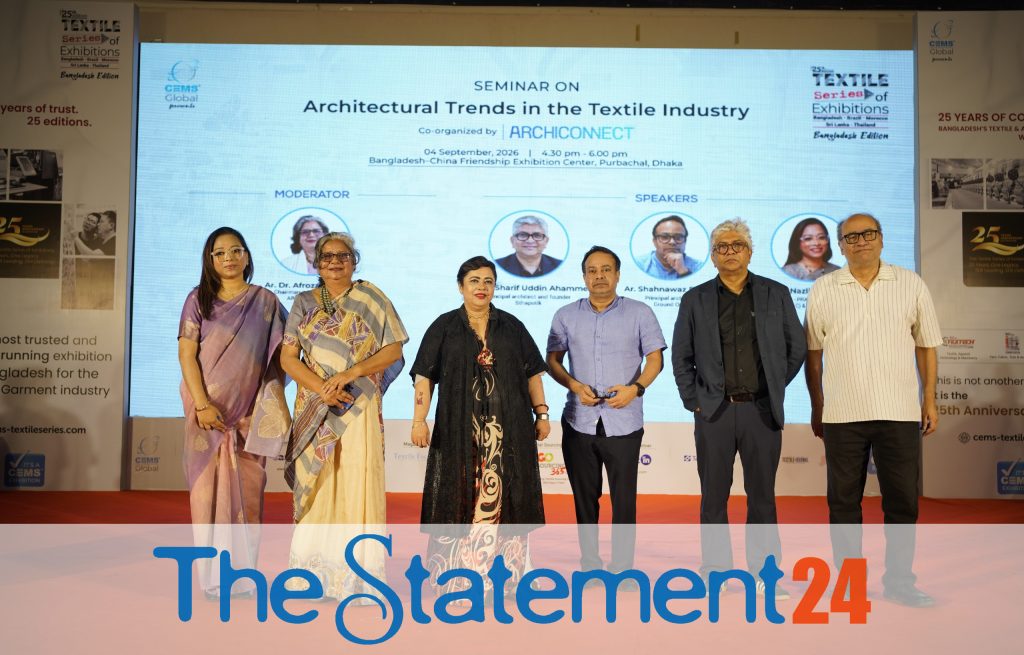
Architects have called for greater emphasis on sustainable, energy-efficient and worker-friendly design in Bangladesh’s textile and garment factories, saying industrial architecture should go beyond production capacity to ensure workers’ safety, comfort and well-being while improving the long-term performance of factory buildings.
They made the remarks at a seminar titled “Architectural Trends in the Textile Industry” held today (Friday) at the Bangladesh-China Friendship Exhibition Centre (BCFEC) in Purbachal, Dhaka, as part of the ongoing 25th Textile Series of Exhibitions 2026.
The seminar was organised by CEMS-Global and held in collaboration with ARCHICONNECT.
Architect Dr Afroze Ahmed, Chairman and Co-founder of ARCHICONNECT, moderated the session. The speakers included Architect Md. Sharif Uddin Ahmed, Principal Architect and Founder of Sthapatik; Architect Shahnawaz Bappi, Principal Architect of Ground One; and Architect Nazli Hossain, Founder of Praxis Architects.
The speakers discussed emerging architectural trends in Bangladesh’s textile and apparel industry, highlighting sustainable construction, the use of natural light and ventilation, energy efficiency, climate resilience, fire safety and the need to create healthier working environments for factory workers.
Sharing his experience from various industrial projects, Architect Md. Sharif Uddin Ahmed said factory buildings should be designed in harmony with the local climate and environment to achieve both environmental and economic benefits.
He stressed that issues such as rainwater harvesting, thermal control of buildings and fire safety should be incorporated from the early stages of the design process rather than being considered later.
Architect Shahnawaz Bappi highlighted the importance of human-centric design in industrial architecture. He said factory design should not focus solely on production activities; workers’ mental well-being, access to nature and the overall quality of the workplace should also be integral to the design.
He cited features such as rooftop gardens, open terraces, internal courtyards and adequate natural light and ventilation as ways to create more comfortable and worker-friendly industrial environments.
Architect Nazli Hossain emphasised the importance of a performance-based approach to sustainable building design. She explained that tools such as energy modelling and lighting simulation can help architects and developers estimate a building’s energy consumption, water efficiency and operational costs during the design stage.
Such approaches, she said, can help reduce long-term operating costs while also lowering the environmental impact of industrial buildings.
Speaking at the seminar, Meherun N. Islam, President and Group Managing Director of CEMS-Global USA & Asia-Pacific, said, “Entrepreneurs in the textile and apparel sector are continuously expanding and modernising their factories. Architects can play an important role in developing modern and sustainable factories while further strengthening the image of Bangladesh’s industry in the international arena through environmentally responsible and worker-friendly design.”
Tanveer Qamrul Islam, Executive Director of CEMS-Global, along with professionals from the textile, apparel and architectural sectors, attended the seminar.
The 25th Textile Series of Exhibitions 2026 is being held from September 2 to 5 at the Bangladesh-China Friendship Exhibition Centre in Purbachal, organised by CEMS-Global. The four-day international exhibition features machinery, yarn, fabrics, accessories, dyestuffs and related technologies for the textile and apparel industries, with participation from local and international companies.