

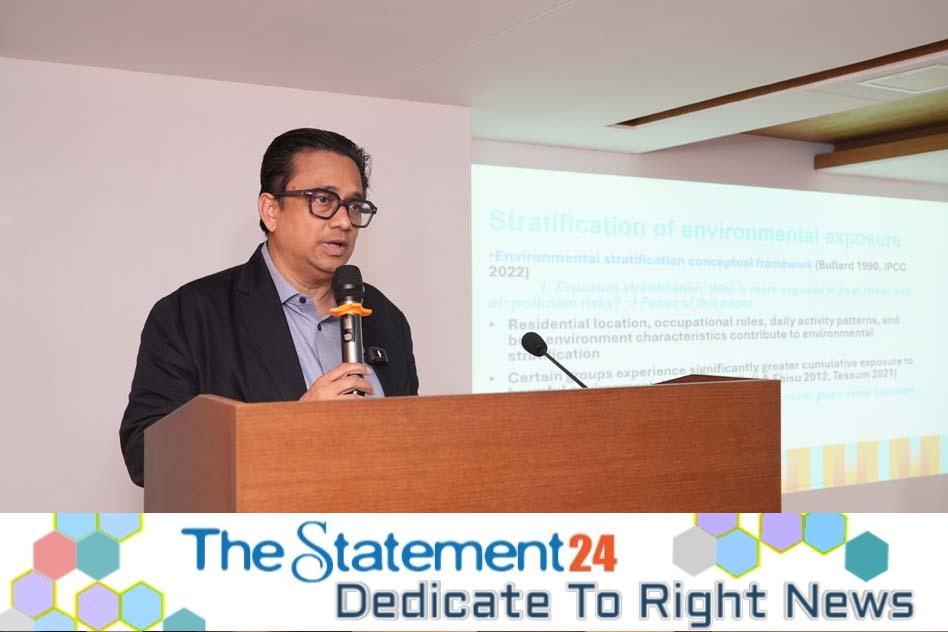
School of Business and Economics of United International University (UIU) organized a seminar titled “The Double Burden of Climate Change: How Heat Stress and Air Pollution Stratify the Workforce” as the second segment of the NEXUS Seminar Series yesterday at UIU Campus. This long-term initiative will serve as an institutional bridge for continuous industry-academia conversations on the intersection of business, economy and society.
Dr. Minhaj Mahmud, Senior Economist, Asian Development Bank (ADB), delivered the keynote lecture titled “The Double Burden of Climate Change: How Heat Stress and Air Pollution Stratify the Workforce”. He highlighted that increasing heat stress and air pollution resulting from climate change are creating a “double burden” that is having a profound adverse impact on workforce productivity and overall economic growth across South and Southeast Asia. Drawing on data-driven research from several Asian countries, he demonstrated that climate risks are unevenly distributed, disproportionately affecting outdoor workers, women, older populations, and densely populated urban centers such as Dhaka. He further noted that the combined effects of rising temperatures and air pollution are not only undermining public health but also exacerbating structural vulnerabilities in the labor market.
He also highlighted that developing a climate-resilient workforce, alongside formulating and implementing evidence-based policies, is essential to ensuring sustainable and inclusive economic growth. He further stressed that, particularly as Bangladesh prepares to graduate from Least Developed Country (LDC) status, adopting short-term and long-term strategic plans to mitigate the economic impacts of climate change has become imperative.
The seminar also included an engaging panel discussion with distinguished experts, including Dr. Nazmul Chaudhury, Principal Economist, Economics Research and Development Impact, ADB and Prof. Abdul Bayes, Former VC, Jahangirnagar University, who were present as the panelists in the program. The panelists discussed the broader implications of climate change on labor markets, economic competitiveness, and sustainable business practices. They emphasized the importance of integrating climate resilience into national development planning, strengthening evidence-based policymaking, investing in climate-adaptive infrastructure, improving occupational safety, and enhancing collaboration among academia, government, development partners, and the private sector to address emerging environmental and workforce challenges.
The Convener of the NEXUS Seminar Series, Professor Dr. M. Niaz Asadullah, said in his speech that the seminar was organized to promote meaningful academic discussions on issues critical to Bangladesh’s economic transformation, climate resilience, and sustainable development. He also noted that the NEXUS Seminar Series serves as an effective platform for fostering the exchange of knowledge and experience among the government, industry and academia.
The seminar was addressed by Prof. Salma Karim, Director, BBA Program, UIU and concluded with an interactive question-and-answer session. The heads of departments, faculty members, researchers, administrative personnel, students and senior representatives from corporate sector were present at the seminar.