

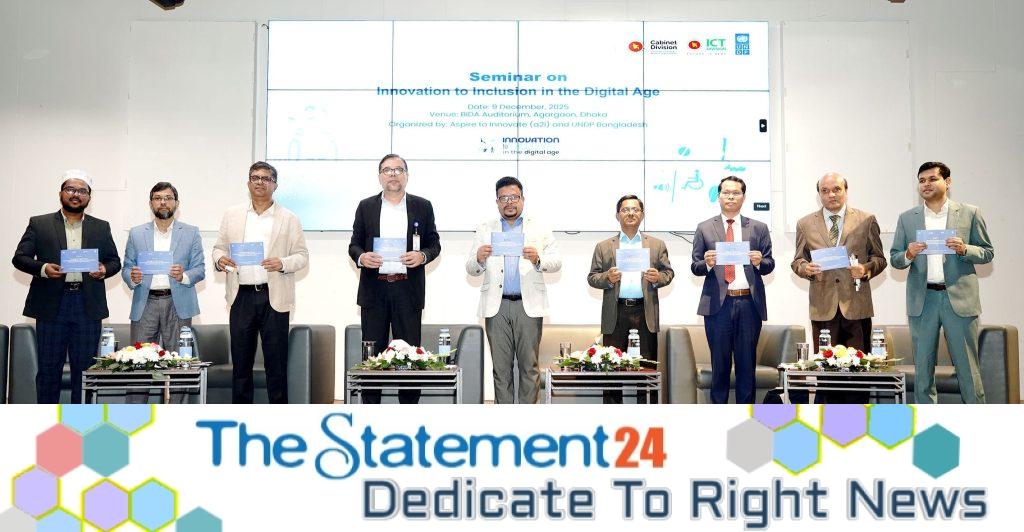
A seminar in Dhaka has called for clear, time-bound measures to make Bangladesh’s expanding digital services accessible to persons with disabilities. Speakers stressed that digital progress will remain incomplete unless all citizens, including those with disabilities, can safely and independently use public e-services. They highlighted the need for affordable internet, regular accessibility checks on government websites and apps, and stronger laws and enforcement to close the gaps that still exclude many users.
The seminar, titled “Innovation to Inclusion in the Digital Age”, was held at the BIDA Auditorium in Agargaon and organised by Aspire to Innovate (a2i) and UNDP Bangladesh. Over 150 participants attended, including representatives from the ICT Division, a2i, Bangladesh Computer Council, the Department of Social Services, UN agencies, development partners, mobile operators, banks, digital payment providers, online learning platforms, civil society, digital accessibility experts, and organisations of persons with disabilities.
Key speakers at the seminar included distinguished guestsShish Haider Chowdhury, Secretary, ICT Division; Md. Saidur Rahman Khan, Director General, Department of Social Services; Bijoy Krishna Debnath, Managing Director, Jatiyo ProtibondhiUnnayan Foundation;Md. RashidulMannaf Kabir, Joint Project Director (Joint Secretary),Programme Management Lead Abdullah Al Fahim; Consultant (Accessibility), Vashkar Bhattacharjee; Anowarul Haq, Assistant Resident Representative,Maha Abu Emier, International Project Manager, and Diversity and Inclusion Officer, Md. Nazmus Sakib, UNDP Bangladesh. The event was chaired by a2i’s Project Director (Joint Secretary) Md. Abdur Rofiq.
At the event, a2i and UNDP Bangladesh shared findings from a new study and policy brief, “Bridging the Digital Divide: Advancing Accessibility for Persons with Disabilities in Bangladesh’s Digital Ecosystem.” The study notes that Bangladesh has introduced more than 1,000 e-services and connected some 33,000 government websites to its broader digital transformation agenda. However, many persons with disabilities still find these services difficult or impossible to use in practice.
Vashkar Bhattacharjee presented the study, which draws on desk reviews, surveys, focus group discussions, workshops, and interviews conducted in Dhaka, Chattogram, Khulna, and Rajshahi. The research identifies several recurring barriers: limited access to assistive devices and affordable internet, low levels of digital skills, unsafe online spaces, and websites and apps that lack accessibility features. The findings also show that women with disabilities face particular risks of online harassment and are less likely to own mobile phones, further restricting their access to digital services.
The presentation included real-life testimonies, such as one woman with a disability who was subjected to online harassment when edited photographs of her were posted on social media. Another participant described that although disability allowance applications are now available online, applicants still have to print the forms and submit them physically, which defeats the purpose of digitalisation and creates extra cost and effort. These stories, the presenters noted, illustrate how design and implementation gaps can turn promising digital reforms into additional burdens for people already facing disadvantages.
Shish Haider Chowdhury emphasised that accessibility has to be integrated from the outset of service design. He noted that while the government is expanding digital services across the country, the next priority is to ensure that each new service is created with accessibility in mind, rather than trying to fix barriers after users complain.
Md. Abdur Rofiq, Project Director (Joint Secretary) of a2i, said that no single institution can close the digital gap alone and that practical, fair solutions emerge when policymakers, technology experts, and disability advocates work together. He stressed that Bangladesh’s digital future must respond to the needs of persons with disabilities, who depend on digital services for education, employment, and daily activities.
Abdullah Al Fahim said, “Accessibility must be treated as a core requirement of public service delivery, not an afterthought. Our experience shows that when services are designed with the most marginalised users in mind, outcomes improve for everyone. The shift we need now is from isolated fixes to a coordinated, system-wide effort where policy, design, technology, and frontline service delivery move in the same direction. Only then can we ensure that persons with disabilities can use digital services with confidence and independence.”
UNDP Assistant Resident Representative Anowarul Haq said that the objective measure of digital progress is not how many platforms exist, but who can use the services. Digital progress is meaningful only when everyone can use it. Inclusion should not be an extra feature. It should be the way we judge whether our digital work is successful, he added.
Md. Saidur Rahman Khan said,“Bangladesh’s commitments need to translate into practical improvements at the service level so that digital platforms become genuinely usable for everyone.”
Bijoy Krishna Debnath stressed that disability services and digital platforms must work together rather than in isolation. He said that organisations working with persons with disabilities cannot remain separate from the digital transition and that accessibility should be built into every mobile app, website, and service that people rely on daily.
The policy brief presented at the seminar sets out a phased roadmap for the next five years. In the first year, it proposes affordable internet packages for persons with disabilities, accessibility audits of all government digital platforms, fuller use of existing design guidelines, and training on digital safety and rights, with particular attention to women and young people with disabilities. It also calls for targeted training for developers and service providers on digital accessibility and for the establishment of digital skills training hubs. Up to the third year, the brief recommends introducing remote identity verification for government allowances, launching a National Disability Helpline that is easy to use in multiple formats, improving the accessibility of digital banking and financial services, and expanding support for assistive devices and local technology innovation. Between the third and fifth years, it suggests enacting a Digital Accessibility Act in line with international standards, creating a Web Accessibility Monitoring Authority under the ICT Division, and ensuring full accessibility for key platforms such as MuktoPaath and NISE.gov.bd, along with making all public information, including emergency alerts, accessible to people with all types of disabilities.
Speakers and participants agreed that, if the recommended actions are carried out, Bangladesh can move towards a digital environment where persons with disabilities are full participants in education, work, public services, and civic life, rather than being left behind.