

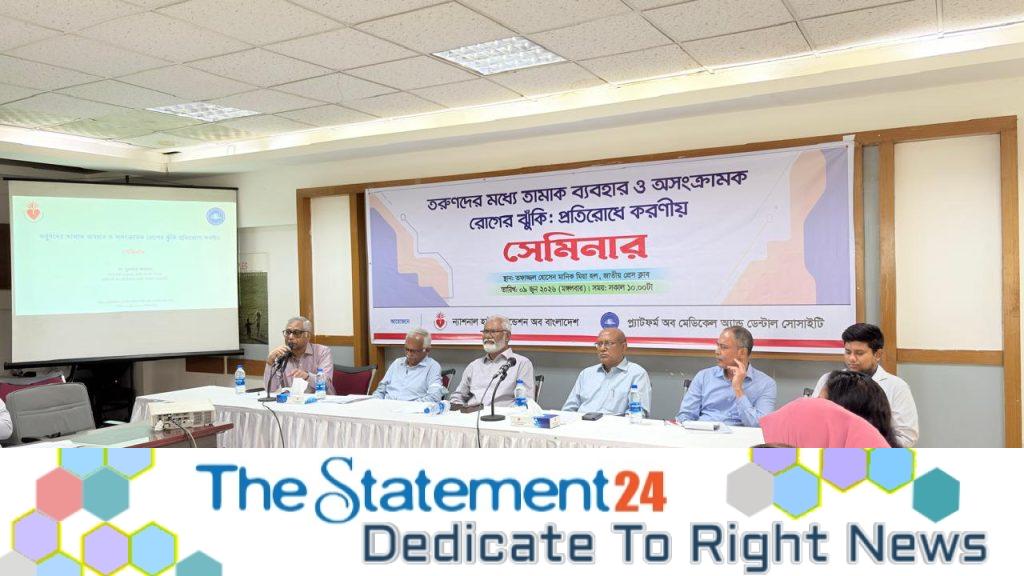
Non-communicable diseases (NCDs) account for nearly 71 percent of all deaths in Bangladesh. Tobacco use is one of the leading risk factors behind this growing burden. Public health experts warn that the low price and easy availability of tobacco products continue to encourage young people to start smoking. To reduce tobacco use among youth and prevent NCDs, doctors and public health experts have called for a significant increase in tobacco taxes and prices in the national budget for FY 2026-27.
The call was made at a seminar titled “Preventing Tobacco Use Among Youth and Reducing the Risk of Non-Communicable Diseases”, held on Tuesday, 9 June 2026, at the National Press Club in Dhaka. The event was organized by the Platform of Medical and Dental Society with technical support from the National Heart Foundation of Bangladesh.
The seminar was inaugurated with a welcome address by Dr. Md. Irfanur Rahman, General Secretary of the Platform of Medical and Dental Society. The keynote paper was presented by Dr. Muntaha Farhan, Director and Head of Human Resources of the organization.
The keynote presentation highlighted that around 37.8 million adults currently use tobacco in Bangladesh. Nearly 200,000 people die prematurely every year from tobacco-related diseases. Tobacco use among young people aged 15–24 stands at 10.3 percent. A recent joint study by the University of Dhaka and Johns Hopkins University found that tobacco use and production caused health and environmental losses worth nearly BDT 87,000 crore in 2024. In contrast, government revenue from the tobacco sector was only about BDT 41,000 crore during the same period.
The presentation proposed major reforms to the cigarette tax structure in the FY 2026-27 budget. These include merging the low- and medium-tier cigarette categories and setting the retail price of a 10-stick pack at BDT 100. It also proposed a specific supplementary tax of BDT 4 per pack and increasing the prices of high-tier and premium cigarettes to BDT 150 and BDT 200 respectively.
Professor Dr. Sohel Reza Choudhury, Head of the Dept. of Epidemiology and Research at the National Heart Foundation Hospital and Research Institute, said that NCDs are now the country’s biggest public health challenge. Tobacco use is a major risk factor for heart disease, stroke, cancer and chronic respiratory diseases. He noted that people who start using tobacco at a young age face a much higher risk of developing NCDs later in life. Therefore, increasing tobacco prices through taxation is essential to protect young people.
Public health expert Dr. Mohammad Mushtuq Husain said that raising tobacco taxes benefits both public health and the economy. Evidence from around the world shows that higher tobacco prices reduce consumption, especially among young people and low-income groups. At the same time, government revenue increases. He added that reforming Bangladesh’s complex multi-tier tobacco tax structure could generate more than BDT 85,000 crore in tobacco tax revenue, about BDT 44,000 crore higher than current collections.
Md. Akhtaruzzaman, Director General (Joint Secretary) of the National Tobacco Control Cell, said the government is implementing its commitment to tobacco control as outlined in its election manifesto. He noted that the tobacco control law has recently been strengthened. According to him, increasing tobacco taxes and prices is one of the most effective measures for achieving a tobacco-free Bangladesh. Higher prices discourage tobacco use, particularly among children, adolescents and young people. He emphasized that stronger tobacco taxation is necessary to protect future generations from the harmful effects of tobacco and nicotine.
Special guest Dr. Sakhawat Hassan Jiban, Member of Parliament for Habiganj-2, stressed the importance of effective tobacco taxation in reducing the burden of tobacco-related diseases. He supported the proposal to merge the low- and medium-tier cigarette categories and set the minimum retail price of a 10-stick pack at BDT 100. He said this would reduce the affordability of cigarettes, discourage youth smoking and increase government revenue.
In his concluding remarks, Professor Dr. Khandoker Abdul Awal Rizvi, President of the National Heart Foundation of Bangladesh, said that effective tobacco taxation is not only a public health measure but also an important development strategy. He noted that the proposed tax reforms could encourage nearly 500,000 adult smokers to quit and prevent more than 372,000 young people from taking up smoking. In the long term, the reforms could prevent around 370,000 premature deaths. They would also significantly increase government revenue, which could be invested in strengthening the health system and expanding services for NCD prevention and treatment.
The seminar was attended by medical students, physicians, public health professionals and journalists. The session was moderated by Dr. Aruna Sarkar, Coordinator of the Tobacco Control Program.