

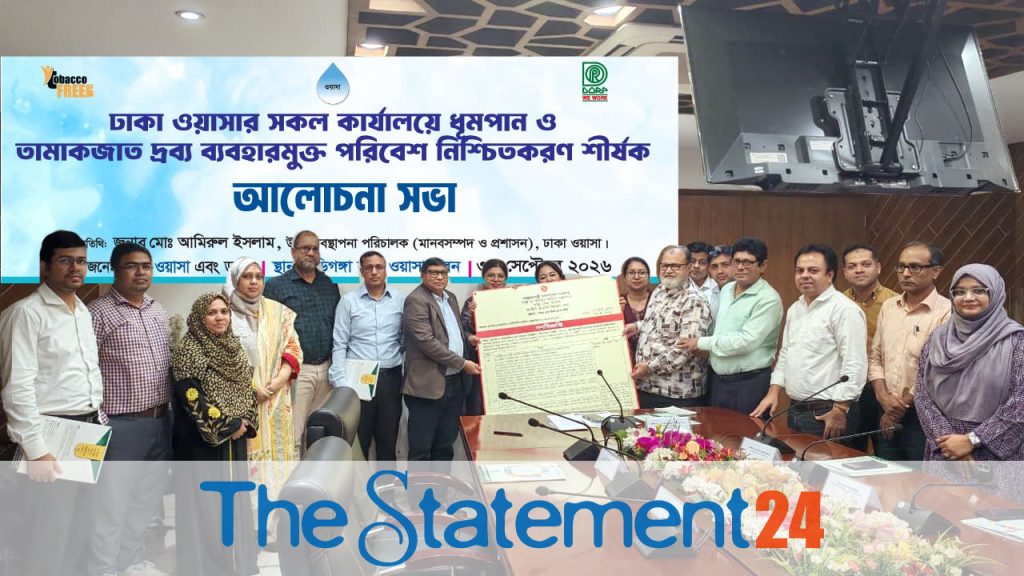
Dhaka WASA is committed to ensuring an environment free from smoking and tobacco products to protect public health and provide citizens with a tobacco-free environment. To achieve this goal, emphasis will be placed on the proper implementation of the relevant provisions of the Smoking and Tobacco Products Usage (Control) Act, 2005 (Amendment 2026). In response to the demand for ensuring a smoke and tobacco products free environment across all Dhaka WASA offices, continuous initiatives will be undertaken in coordination with relevant stakeholders, said A K A M Fazlul Haque, Deputy Managing Director (Human Resources and Administration) of Dhaka WASA.
He expressed this commitment as the chief guest at a discussion meeting titled “Ensuring a Smoke and Tobacco Products Usage Free Environment in All Dhaka WASA Offices,” jointly organized by Dhaka WASA and Development Organisation of the Rural Poor-DORP at the WASA Bhaban in the capital on Wednesday, September 30, 2026.
Zeba Afroza, Coordinator of DORP’s Tobacco Control Project, presented the keynote paper at the meeting. She said that a significant portion of Bangladesh’s adult population uses tobacco products, while a large number of people are exposed to secondhand smoke in workplaces, public places and public transport. According to the Global Adult Tobacco Survey (GATS) 2017, approximately 37.8 million adults in Bangladesh use tobacco products. The same survey indicates that approximately 38.4 million adults are exposed to secondhand smoke in workplaces, public places and public transport. In terms of percentages, 42.7 percent of adults were exposed to secondhand smoke in indoor workplaces, 44 percent on public transport and approximately 49 percent in restaurants. A study published in Lancet also found that approximately 1.7 million people worldwide died due to secondhand smoke in 2023. Therefore, secondhand smoke is as harmful as direct smoking, and protecting workplaces and public gathering spaces from its harmful effects is essential.
Zeba Afroza further said that tobacco related diseases and premature deaths are placing significant pressure on public health and the economy. Approximately 200,000 people die prematurely every year from tobacco related diseases, while the overall economic loss caused by tobacco use, including healthcare expenditure and loss of productivity, is approximately BDT 870 billion. As tobacco control is considered an important public health priority, she expressed hope that Dhaka WASA’s initiative would serve as a positive example for other public and private institutions across the country.
The meeting was chaired by Dhaka WASA Secretary Muhammad Abdul Hai Milton. He said that in the Prime Minister’s message marking World No Tobacco Day 2026, it was stated, “The government is committed to protecting children, adolescents and future generations from the harmful effects of tobacco and nicotine.” He further said that the prohibition of smoking and the use of tobacco products in public places and public transport is part of the government’s commitment to fulfilling this pledge.
Speakers at the discussion meeting said that raising public sensitization about the harmful effects of tobacco, strengthening Dhaka WASA’s institutional capacity for tobacco control and ensuring coordinated efforts among all relevant stakeholders are crucial to creating a smoke and tobacco free and healthy workplace. They also emphasized the importance of ensuring the proper implementation of relevant laws and regulations.
DORP representatives informed the meeting that coordinated initiatives would be undertaken to install necessary public notices, warning signs and other relevant materials across all Dhaka WASA offices to ensure a smoke and tobacco products usage free environment. At the same time, continuous activities will be carried out to ensure a healthy, safe and tobacco free workplace for employees.
Officials from different levels of Dhaka WASA and representatives of DORP were present at the meeting.