

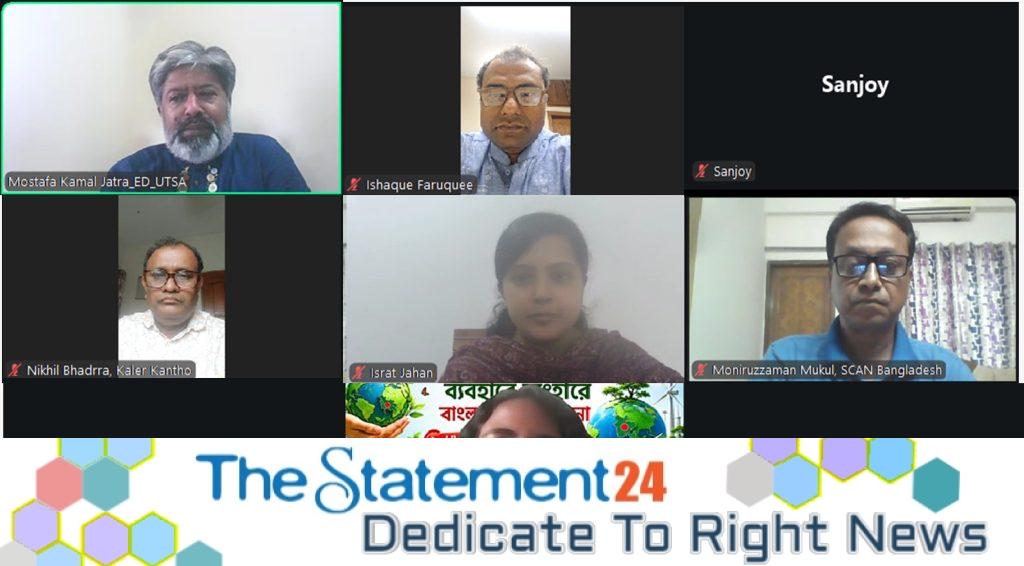
On the occasion of World Environment Day, a virtual discussion titled “Bangladesh’s Potential for Renewable Energy Use in Environmental Protection and Sustainable Development” was organized jointly by Zabarang Kalyan Samity and PSDI Foundation, with technical support from PSDI Consultancy. Environmental activists, researchers, development professionals, media representatives, and youth leaders from different parts of the country participated in the event.
The world is currently facing a severe climate crisis. Protecting the environment, reducing carbon emissions, and expanding the use of renewable energy have become urgent global priorities.
The discussion was moderated by Nibedita Barma, Chairperson of PSDI Foundation, and chaired by Sanjoy Majumder, General Secretary of the organization. The keynote paper was presented by Ishrat Jahan, Assistant Professor of Environmental Science at Bangladesh University of Professionals (BUP). Guest speakers included Mostafa Kamal Jatra, Executive Director of UTSA; Nikhil Chandra Bhadra; Ishaque Faruquee, Acting Editor of Captain’s TV; and Md. Moniruzzaman Mukul, General Secretary of the Street Children Activist Network.
In her keynote presentation, Professor Ishrat Jahan stated that Bangladesh currently has significant potential in the energy sector and must become more proactive in reducing dependence on fossil fuels for electricity generation. At the same time, people should be encouraged to adopt renewable energy solutions. Increasing investment in renewable energy is essential to achieving Sustainable Development Goal 7 (Affordable and Clean Energy) and Sustainable Development Goal 13 (Climate Action). She highlighted the country’s prospects in solar energy, wind energy, biogas, and waste-to-energy technologies. Given Bangladesh’s geographical and social realities, decentralized renewable energy systems can play a vital role in rural development and environmental protection.
Mostafa Kamal Jatra noted that renewable energy is increasingly recognized worldwide as one of the most effective solutions for reducing carbon emissions. Although Bangladesh has strong potential for solar power generation, technological limitations, inadequate financing, policy barriers, and a shortage of skilled human resources continue to hinder sectoral growth. He emphasized the need for long-term planning, research, innovation, and stronger public-private partnerships to address these challenges.
Nikhil Chandra Bhadra pointed out that coastal communities are among the most vulnerable to the impacts of climate change. Rising sea levels, salinity intrusion, and cyclones are placing the lives and livelihoods of coastal populations at increasing risk. He stressed that expanding renewable energy use and reducing carbon emissions can help mitigate environmental risks while contributing to the development of climate-resilient communities.
Ishaque Faruquee stated that sustainable change cannot be achieved without raising public awareness about environmental and climate issues. In particular, young people should be encouraged to adopt environmentally friendly lifestyles, embrace green technologies, and utilize renewable energy. He highlighted the critical role of the media in disseminating positive messages about the benefits, opportunities, and necessity of renewable energy.
Md. Moniruzzaman Mukul emphasized the need for adequate budget allocations for renewable energy, environmental conservation, and climate adaptation initiatives in the national budget. He noted that environmental protection and climate action are not one-day events but continuous processes that require coordinated efforts from government institutions, private organizations, development agencies, and the general public.
In his concluding remarks, Sanjay Majumdar stated that there is no alternative to coordinated action in addressing climate change and environmental challenges. Government agencies, private sector organizations, research institutions, civil society groups, and youth organizations working on environmental protection, climate action, and renewable energy must collaborate closely. To ensure sustainable development, environmental protection must be placed at the center of development planning. Through the expansion of renewable energy, implementation of environmentally friendly policies, and greater public engagement, Bangladesh can make significant progress toward building a greener, safer, and more sustainable future.
The discussion concluded with several key recommendations, including:
Conducting nationwide awareness campaigns on renewable energy;
Increasing the active participation of civil society, educational institutions, and youth in environmental protection efforts;
Identifying and promoting new investment opportunities in solar, wind, biogas, and other green energy sectors;
Developing effective policies, action plans, and implementation frameworks for renewable energy development;
Ensuring the participation of local communities in climate adaptation and mitigation initiatives;
Prioritizing research, technological innovation, and human resource development in the environment and energy sectors;
Ensuring adequate national budget allocations for renewable energy and environmental protection programs; and
Creating opportunities for future collaboration, joint initiatives, and knowledge-sharing among the organizing institutions and other relevant stakeholders.
The speakers collectively underscored that accelerating the transition to renewable energy is crucial for environmental protection, climate resilience, and achieving sustainable development in Bangladesh.