

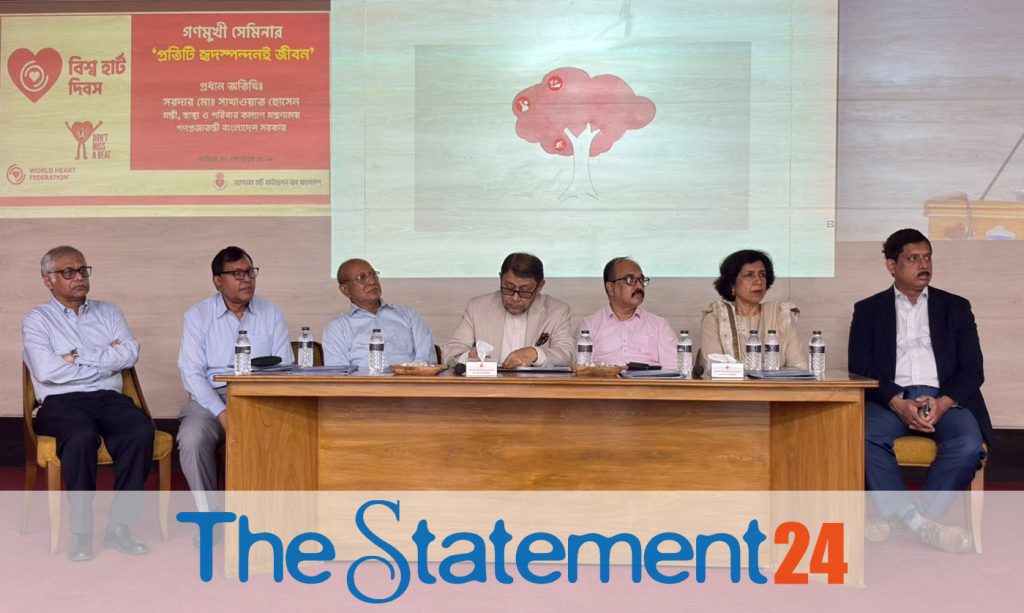
A public seminar was held today September 30, 2026 to mark World Heart Day 2026, organized by the National Heart Foundation of Bangladesh under the theme “Every Heartbeat Matters.” The seminar, held at the auditorium of the National Heart Foundation Hospital and Research Institute, focused on cardiovascular disease prevention, risk reduction, timely treatment and tobacco control.
The seminar was chaired by Professor Dr. Khondker Abdul Awal Rizvi, President of the National Heart Foundation of Bangladesh. Health and Family Welfare Minister Sardar Md. Sakhawat Husain attended as the chief guest, while Sharif Uddin Ahmed Choudhury, Secretary of the Ministry of Textiles and Jute, and Professor Dr. Nazmul Hosain, Director General of the Directorate General of Health Education, attended as special guests.
In her welcome address, Professor Fazila-Tun-Nessa Malik, Secretary General of the National Heart Foundation of Bangladesh, said that more than 20.5 million people die from cardiovascular disease worldwide every year. According to the World Heart Federation, cardiovascular disease remains the world’s leading cause of death, while the World Health Organization estimates that up to 80 percent of heart attacks and strokes are preventable.
She emphasized that, alongside treatment, greater attention should be given to controlling risk factors and strengthening preventive measures. She said the National Heart Foundation works throughout the year to prevent cardiovascular disease through research, public awareness and advocacy.
Presenting the keynote paper, Professor Dr. Sohel Reza Choudhury, Head of the Department of Epidemiology and Research at the National Heart Foundation Hospital and Research Institute, said, “Preventing cardiovascular disease does not depend solely on individual awareness; effective public health policies and stronger primary healthcare capacity are also essential.”
He put forward three recommendations to reduce the risk of cardiovascular disease: taking effective measures to control tobacco use and expediting the formulation of rules under the Tobacco Control Act 2026; ensuring adequate budgetary allocation for the management of hypertension and diabetes at the primary healthcare level; and reducing salt intake in line with the recommendations of the World Health Organization. He said coordinated implementation of these measures could play an effective role in reducing the risk of cardiovascular disease in Bangladesh.
In his address, Professor Dr. Nazmul Hosain, Director General of the Directorate General of Health Education, said it is essential to identify cardiovascular risk factors at an early stage. Controlling risk factors such as hypertension, diabetes, unhealthy diet, physical inactivity and tobacco use can significantly reduce the burden of cardiovascular disease. He stressed the need to strengthen preventive healthcare alongside health education and public awareness.
Sharif Uddin Ahmed Choudhury, Secretary of the Ministry of Textiles and Jute, said preventing cardiovascular disease requires coordinated action not only from the health sector but also from all relevant institutions. He emphasized the importance of ensuring tobacco-free workplaces and taking effective measures to regulate the use of e-cigarettes and other emerging nicotine products.
As the chief guest, Health and Family Welfare Minister Sardar Md. Sakhawat Husain said government initiatives would continue to make cardiovascular disease prevention and treatment more accessible to the people. He emphasized the importance of raising public awareness, strengthening tobacco control, promoting healthy lifestyles and ensuring early detection of cardiovascular disease.
He further said the government is committed to bringing positive changes to the country’s healthcare system. To this end, the government has undertaken various initiatives, including the recruitment of doctors, to bring healthcare services closer to the people.
In his presidential address, Professor Dr. Khondker Abdul Awal Rizvi, President of the National Heart Foundation of Bangladesh, said cardiovascular disease prevention requires more than treatment services; it requires coordinated and long-term efforts to address the underlying risk factors. Tobacco use, hypertension, diabetes, unhealthy diet and physical inactivity are among the major risk factors for cardiovascular disease. Alongside raising public awareness, effective public health policies and preventive healthcare services must be ensured to reduce these risks.
He said, “The government, physicians, researchers, media, civil society and the public must work together to prevent cardiovascular disease. In particular, it is essential to ensure early identification of cardiovascular risk factors and appropriate treatment at the primary healthcare level. The National Heart Foundation will continue its efforts to advance policy initiatives for cardiovascular disease prevention alongside research, healthcare services and public awareness.”
Naushad Hossain, Joint Secretary General of the National Heart Foundation of Bangladesh, delivered the vote of thanks.
Officials and representatives from different levels of the Foundation, physicians, healthcare professionals, media personnel and representatives of relevant organizations attended the seminar.
On the occasion of World Heart Day, the National Heart Foundation organized various activities, including free cardiovascular screening camps and the distribution of awareness posters and leaflets. The Foundation’s 45 affiliated bodies outside Dhaka also observed the day through various awareness and preventive activities.
Earlier, on September 29, a colorful rally was organized from the area in front of the National Cricket Stadium in Mirpur, Dhaka, to mark World Heart Day. The rally passed through the main roads and ended in front of the National Heart Foundation Hospital and Research Institute. Several hundred people participated in the rally.
The 2026 World Heart Day campaign emphasizes the message “Don’t Miss a Beat”, highlighting the importance of recognizing the signs and symptoms of cardiovascular disease and taking timely action.