

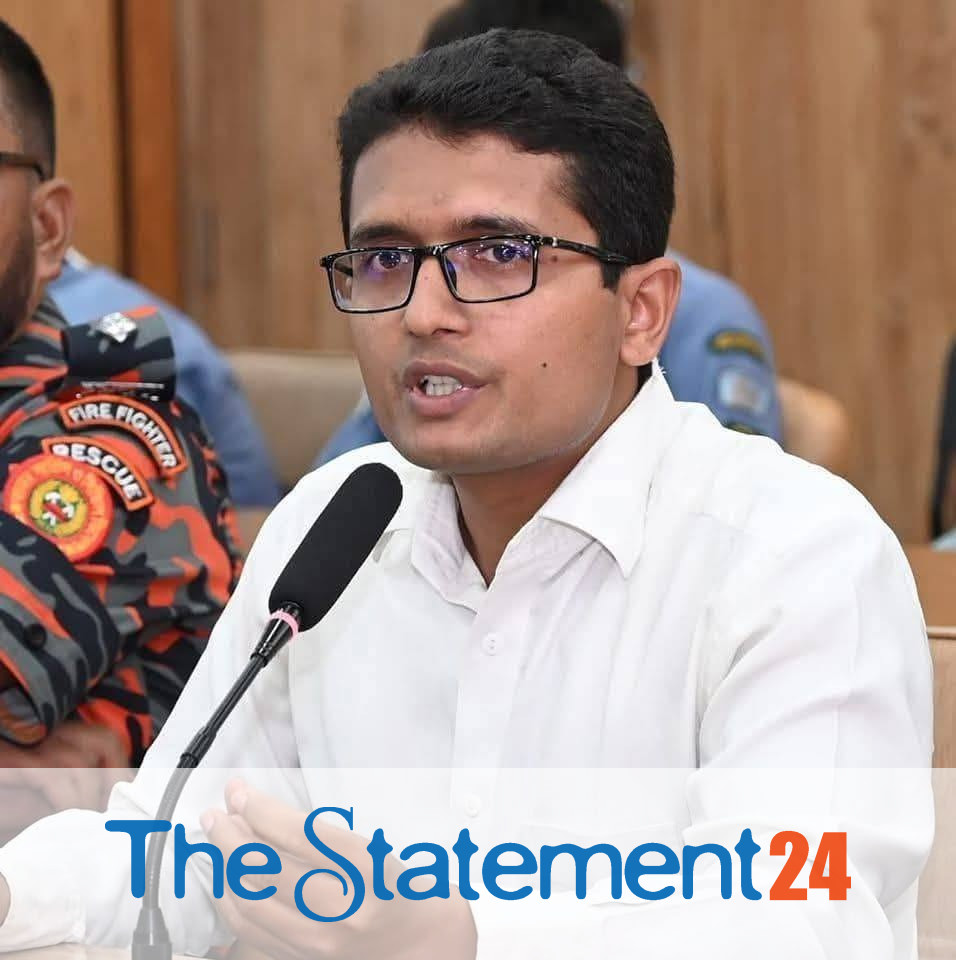
- Kazi Mohammad Hasibul Huq
Smoking on public transport is prohibited in Bangladesh, and the law provides for fines for violations. Yet despite these legal provisions, smoking continues to occur on buses, minibuses and other forms of public transport. The problem is particularly difficult when a violation takes place on a moving vehicle. A passenger or transport worker may smoke for only a few minutes, making it difficult for conventional enforcement mechanisms to respond in time. This raises a fundamental question: when a violation occurs, who can act immediately, who can document the offence, and who can impose the appropriate penalty?
The issue has become more important following the Smoking and Tobacco Products (Control) (Amendment) Act, 2026, which was gazetted on April 10, 2026. The amendment increased the fines for smoking and using tobacco products in public places and public transport. In other words, Bangladesh has already strengthened the law. The next challenge is to ensure that stronger penalties translate into stronger enforcement on the ground.
The problem, however, should not simply be described as a lack of police authority. Bangladesh’s tobacco-control law already recognizes the concept of an “authorized officer.” Under Section 9, an authorized officer may enter and inspect public places and public transport within his or her jurisdiction and may remove a person who violates the law. The Smoking and Tobacco Products (Control) Rules, 2015, issued on March 19, 2015, further developed this enforcement framework and included police officers of specified ranks among officials associated with the authorized-officer structure.
But there is an important legal distinction between being an authorized officer and having the power to impose a fine directly at the scene. Under the existing framework, police officers can identify violations, conduct inspections and initiate necessary legal procedures. However, direct authority to impose a monetary penalty under the tobacco control law does not automatically arise merely from holding a particular police rank. In practice, fines for tobacco-control offences are more commonly imposed through mobile courts conducted by Executive Magistrates.
This distinction points to the real policy question: Can trained police officers of specified ranks be given limited and clearly defined legal authority to impose fines for specified tobacco-control offences, while maintaining due process, accountability and appropriate safeguards? This question deserves serious legal and policy consideration.
The issue is particularly urgent on moving public transport. Unlike many other offences, smoking on a bus can begin and end within minutes. Expecting an Executive Magistrate to reach the vehicle every time a passenger or transport worker violates the smoking prohibition is not always realistic. Police officers, however, are already present on roads, at bus terminals, transport hubs and other important points. They routinely interact with public transport as part of their regular duties. Their presence therefore creates an opportunity to strengthen enforcement at the point where violations actually occur.
Giving police such authority would not necessarily mean transferring the judicial functions of Executive Magistrates to the police. Instead, Bangladesh could examine a narrowly defined enforcement model in which trained police officers of specified ranks are authorized, under specific legal conditions, to impose penalties for clearly identified offences or to initiate an expedited process leading to action by an Executive Magistrate.
This approach should also be considered alongside the Road Transport Act, 2018. Section 49 establishes general provisions concerning the operation of motor vehicles, while Section 92 provides penalties for violations of specified provisions. However, it is important not to confuse the two legal frameworks. The current Section 49 of the Road Transport Act, 2018 does not itself expressly state that smoking on public transport is prohibited. The primary legal basis for prohibiting smoking on public transport remains the tobacco control law. The Road Transport Act should therefore be treated as a complementary framework for strengthening compliance and enforcement within the transport sector, rather than as a substitute for tobacco-control legislation.
In particular, the responsibilities of drivers, conductors and other transport workers could be more clearly linked to the obligation to maintain smoke-free public transport. Their codes of conduct, passenger-service responsibilities and operational duties could incorporate stronger compliance requirements. This would help make a smoke-free bus not merely a legal expectation placed on passengers, but a responsibility shared by the entire transport system.
Bangladesh also does not need to create an entirely new enforcement structure. The existing law and the 2015 Rules already provide a foundation for police involvement. The inclusion of police officers within the authorized-officer framework demonstrates that their role in tobacco-control enforcement has already been recognized. What remains unclear is how effectively an officer who witnesses a violation can move from identifying that violation to taking immediate and legally effective action. This is the enforcement gap that now needs to be addressed.
There are several possible ways forward. One option would be to examine whether existing or future tobacco-control laws and Rules can provide limited enforcement powers to police officers of specified ranks. A second would be to amend the tobacco control law or relevant Rules to authorize designated police officers to impose fines directly for clearly specified offences. A third would be to strengthen the police’s first-response role without giving direct fining authority, allowing officers to identify offences, collect preliminary evidence, receive complaints and document violations before rapidly referring the matter to an Executive Magistrate through a mobile-court or Magistrate enforcement mechanism. A fourth possibility would be to consider whether an order issued under the authority provided by the second part of Section 49(2) of the Road Transport Act, 2018 could authorize designated police officers to impose fines for specified offences arising from violations of specified provisions.
Which model is most appropriate should not be determined by one institution alone. A coordinated legal and policy review involving the Ministry of Law, Ministry of Health, Ministry of Home Affairs, Bangladesh Police, National Tobacco Control Cell and relevant legal experts would be appropriate. The objective should not be to expand police powers for their own sake. It should be to establish an enforcement system that is legally sound, operationally realistic and accountable.
Any expansion of police enforcement authority must also be accompanied by a clear Standard Operating Procedure (SOP). Such an SOP should specify which ranks of police officers may exercise the authority, which offences may result in an immediate fine, how violations and preliminary evidence will be documented, how passenger complaints will be received and verified, and how the accused person’s statement will be recorded. It should also establish how receipts or digital challans will be issued, how collected money will be deposited into the government treasury, how repeated offences will be recorded, when liability may extend to drivers, conductors or transport owners, and what accountability measures will apply if an officer abuses the authority. There must also be a clear mechanism for review or other legal remedy against a fine.
In other words, authority must be accompanied by accountability. Enforcement powers without safeguards could create opportunities for arbitrary or inconsistent application of the law. A modern enforcement framework must therefore combine authority with transparency, due process and institutional oversight.
At the same time, making public transport smoke-free cannot depend solely on penalizing individual passengers. Transport owners, drivers, conductors and other workers should also have clearly defined responsibilities. Every bus and other public transport vehicle should display prominent signage stating, “Smoking and the Use of Tobacco Products Are Prohibited.” Drivers and conductors should receive appropriate training, and passengers should have simple and accessible mechanisms for reporting violations.
Transport owners and management authorities should also be included in a compliance mechanism. If repeated complaints of smoking arise against a particular vehicle or operator, those complaints should be recorded and communicated to the relevant transport authority or management. This would help shift enforcement from a narrow model of individual punishment toward a broader model of institutional compliance.
The role of the police should therefore be understood as that of an effective enforcement partner, not the entire tobacco-control system. Tobacco control is fundamentally a public-health policy issue. Police officers can form one part of an integrated enforcement chain by identifying offences, receiving complaints, documenting evidence, following the prescribed legal process and, where legally authorized, imposing the applicable penalty. Health authorities, local administration, the Bangladesh Road Transport Authority and tobacco-control institutions can continue to focus on policy, training, monitoring, compliance and public awareness.
Such a division of responsibility would be consistent with a modern regulatory approach: law enforcement at the point of violation, public-health leadership at the policy level, and accountability throughout the enforcement chain.
Bangladesh’s international tobacco-control commitments also reinforce the importance of effective implementation. The existence of legislation is not, by itself, evidence of effective tobacco control. Laws must be implemented in ways that meaningfully protect people from tobacco use and exposure in their everyday lives. A smoke-free public transport system is therefore not merely a domestic regulatory objective; it is part of a broader public-health commitment to protect people from tobacco-related harm.
This is why enforcement matters. A prohibition that cannot be consistently enforced risks becoming symbolic. A penalty that is rarely applied loses much of its deterrent value. And the public’s right to a smoke-free environment means little if people cannot rely on the state to protect that right when violations occur.
Bangladesh has already taken the legislative step of strengthening penalties. The next step should be to strengthen the institutional capacity required to make those provisions effective.
Ultimately, the question should not be reduced to “Who should impose the fine?” The more important question is whether Bangladesh has a lawful, rapid and accountable mechanism capable of responding when the prohibition on smoking is violated inside a bus or other public transport vehicle.
If the answer is no, then the country faces an enforcement problem-not simply a legislative one.
The existing law and the 2015 Rules have already established the concept of authorized officers and created a basis for police involvement. What is now required is a careful reassessment of that framework and, where necessary, targeted legal reform. That reform could take the form of amendments to the law, amendments to the Rules, lawful delegation of authority, or an integrated enforcement mechanism linking police officers with Executive Magistrates.
If direct fining authority for police officers is ultimately found to be legally inappropriate, that should not result in inaction. Police officers can still be given a strong first-response role, enabling them to identify, document and immediately refer violations to the appropriate Magistrate or enforcement authority.
The objective should be simple: a violation should not disappear merely because it occurred inside a moving bus.
Bangladesh now has an opportunity to move from legislation to implementation. The relevant ministries, National Tobacco Control Cell, Bangladesh Police, Bangladesh Road Transport Authority, local administration, transport owners and workers, and legal experts should work together to establish a clear, lawful and practical enforcement mechanism.
That mechanism should combine clear authority, rapid response, due process, transparent financial procedures, institutional accountability, monitoring and public participation.
The goal is not simply to issue more fines. The goal is to ensure that the law protecting passengers from tobacco smoke is enforceable where and when violations actually occur.
Laws are not enacted merely to exist on paper. They are enacted to protect people in their everyday lives.
Author: Kazi Mohammad Hasibul Huq, Public Health and Environment Development Worker