

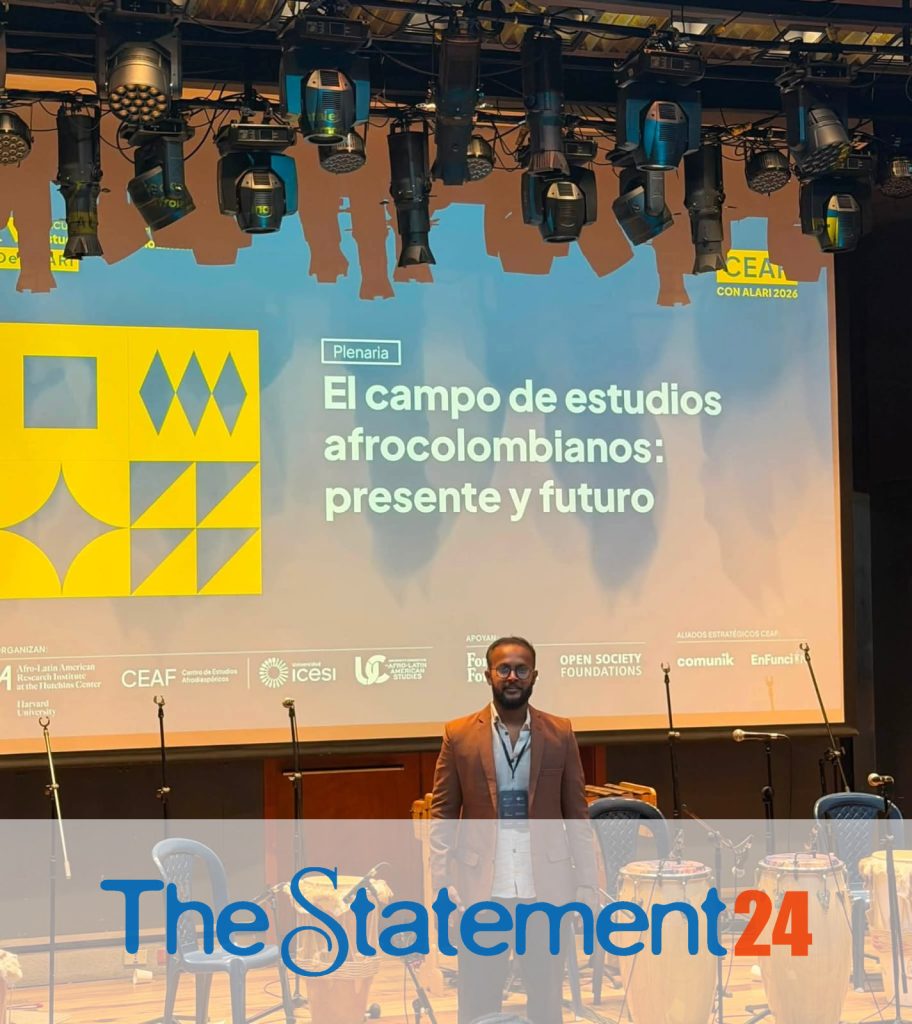
Bangladeshi researcher Ahmed Sajidan Jarjis Rafsan has represented Bangladesh as one of the youngest panellists at an international conference organised by Harvard University’s Afro-Latin American Research Institute (ALARI) in Cali, Colombia.
The conference brought together scholars, researchers, writers, cultural practitioners and community leaders from different parts of the world to discuss Afro-Latin American history, culture, identity, representation and knowledge production.
Rafsan was the only Bangladeshi participant and among the youngest panellists at the conference, according to his account.
He shared the panel with prominent scholars, including Harvard professors Alejandro de la Fuente, Paulina Alberto, Jesse Hoffnung-Garskof, Doris Sommer, Sidney Chalhoub, Amber Henry and Yanilda María González.
For Rafsan, participation in the conference was both an honour and a responsibility, particularly as a young researcher from the Global South representing Bangladesh in an international academic forum.
He also acknowledged the encouragement of Prof Alejandro de la Fuente, founding director of ALARI, saying his recognition of emerging humanities researchers from the Global South had encouraged him to pursue his work with greater confidence.
Rafsan’s research focuses on the Caribbean Studies Lab, which works on Afro-Caribbean, Afro-Latin American and Indigenous histories, cultural memory, climate change experiences and community knowledge.
The initiative seeks to connect marginalised communities and their knowledge with international academic research, while building intellectual links between Bangladesh, the Caribbean, Latin America and the wider Global South.
Rafsan has argued that knowledge production should not remain confined to major universities and research institutions, saying the experiences of fishermen, farmers, artists, Indigenous elders, refugees and other marginalised communities should also be recognised as valuable sources of knowledge.
His research interests also reflect broader connections among communities affected by colonial histories, displacement, climate change, identity struggles and efforts to preserve and reclaim their own histories.
“Bangladesh is my identity and my strength, but my work and aspirations go beyond borders,” Rafsan said.
The confounder of the Caribbean studies lab said his broader goal is to build connections among people across regions through their memories, dignity and voices.
The participation at the Harvard-affiliated conference comes as part of Rafsan’s broader engagement with international research and academic networks focused on the Global South, diaspora, cultural memory and community-based knowledge.
Alejandro saying Rafsan’s one of the best emerging humanities scholar and practitioners from the Global South.