

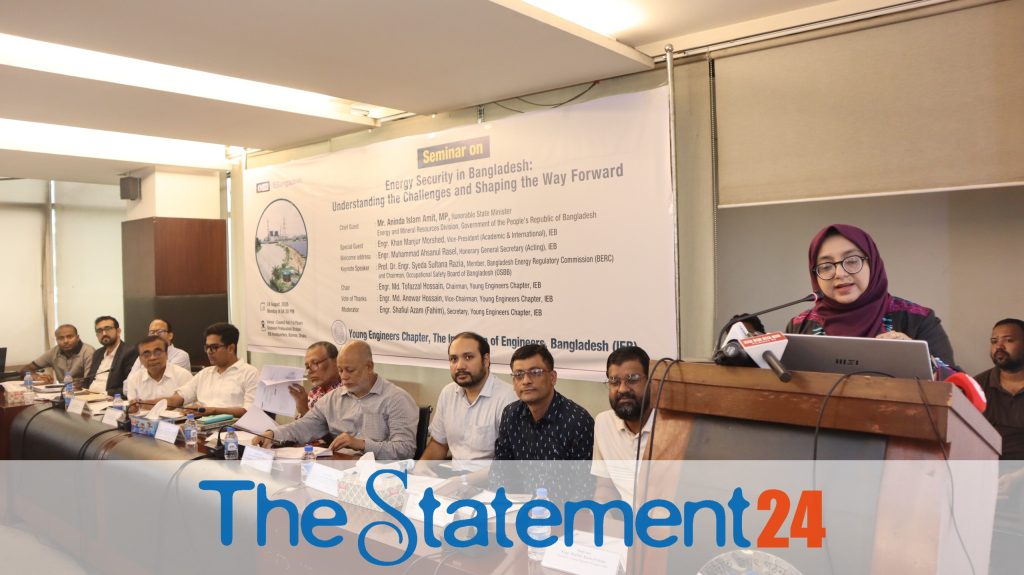
Bangladesh must diversify its energy mix, reduce fuel wastage, improve efficiency and embrace modern technologies to ensure long-term energy security, experts said on Monday.
They made the remarks at a seminar titled “Energy Security in Bangladesh: Understanding the Challenges and Shaping the Way Forward”, organized by the Young Engineers Chapter of the Institution of Engineers, Bangladesh (IEB).
The seminar was held at the Council Hall of the IEB headquarters at Shahid Engineer Bhaban in Ramna, Dhaka, on Monday afternoon.
Energy security requires a broader approach
Presenting the keynote paper, Bangladesh Energy Regulatory Commission (BERC) member Professor Dr Engineer Syeda Sultana Razia said uninterrupted and affordable energy supply is essential for Bangladesh’s economic development, industrialization and daily life.
She identified declining domestic gas reserves, dependence on imported fuels, rising international energy prices, pressure on foreign exchange and limitations in power generation and supply as major challenges to the country’s energy security.
“Energy security should not be viewed only from the perspective of power generation. It needs to be considered as an integrated issue involving the economy, industry, environment and national security,” she said.
She called for diversification of energy sources through increased domestic gas exploration and greater use of solar, wind, hydropower and other renewable energy sources.
Experts call for greater use of technology
Syeda Sultana Razia also stressed the need to improve energy efficiency in the industrial, transport and building sectors.
She recommended wider adoption of smart grids, energy storage systems, Internet of Things (IoT), artificial intelligence (AI) and digital monitoring technologies.
Regional cooperation in electricity and energy, long-term planning and stronger engineering leadership can also help reduce risks to energy supply, she said.
“Proper planning, technological advancement, expansion of renewable energy and efficient management can help Bangladesh build a secure, affordable and sustainable energy future,” she added.
IEB raises concerns over energy wastage
Speaking as a special guest, IEB Vice-President (Academic and International) Engineer Khan Manzur Morshed said the IEB headquarters had already organized four seminars on energy security.
The recommendations from those discussions are being consolidated for publication, he said, adding that the initiative would provide a comprehensive direction on the problems, prospects and way forward for the energy sector.
He identified energy wastage and inefficient use as major contributors to the country’s energy crisis.
“Excessive energy consumption and unplanned expenditure are creating additional pressure on our limited energy resources,” he said.
He also questioned the need for unnecessary foreign trips by some officials at public expense at a time when the country is facing an energy crisis.
“Those responsible should show greater attention and accountability on such an important national issue,” he said.
Manzur Morshed also raised concerns about assigning important technical positions to non-technical personnel who lack adequate engineering and technological knowledge.
“Qualified, experienced and skilled engineers should be given appropriate responsibilities in technical institutions and important projects,” he said.
Calls for review of power projects
The IEB vice-president questioned whether adequate feasibility studies had been conducted before several power plants were established in the past.
He said authorities should review whether fuel sources, supply arrangements, costs and long-term fuel availability were properly assessed before approving such projects.
“Establishing a power plant cannot be based only on its generation capacity. Fuel availability, economic viability, operating costs and long-term sustainability must also be considered,” he said.
He called for transparent and independent investigations into projects that were implemented without adequate planning, technical assessment or feasibility studies and are now creating financial and operational pressure on the state.
“If investigations find evidence of irregularities, mismanagement, negligence or misuse of public funds, those responsible should be held accountable under the law,” he said.
IEB to send recommendations to authorities
In his welcome speech, IEB Honorary General Secretary (Acting) Engineer Muhammad Ahsanul Russell said IEB has been playing an important role in the professional development of engineers and national development.
He said the organization currently operates through 18 centres, 35 sub-centres, 14 overseas chapters, seven engineering divisions, two engineering chapters and five boards.
The recommendations emerging from the seminar will be carefully considered and sent to the relevant ministries and authorities, Russell said.
“This will help ensure that the recommendations can be effectively reflected in national policymaking and implementation,” he said.
Panel discussion
Engineer Helal Uddin Talukder, chairman of the IEB Dhaka Centre; Dr Md Aman Uddin, associate professor of Mechanical Engineering at Bangladesh University of Engineering and Technology (BUET); and Md Sajidul Islam, head of Corporate Planning and Business Development at Omera Petroleum Ltd, took part in the panel discussion.
The seminar was chaired by Engineer Md Tofazzel Hossain, chairman of the IEB Young Engineers Chapter.
Engineer Shafiul Azam (Fahim), secretary of the Young Engineers Chapter, moderated the event, while Engineer Md Anwar Hossain, vice-chairman of the chapter, delivered the vote of thanks.
IEB Honorary Assistant General Secretary (S&DW) Engineer Sabbir Ahmed Osmani, Honorary Assistant General Secretary (HRD) Engineer Md Nur Amin, leaders of various engineering divisions and chapters, members of the central council and engineers from different engineering organizations also attended the seminar.