

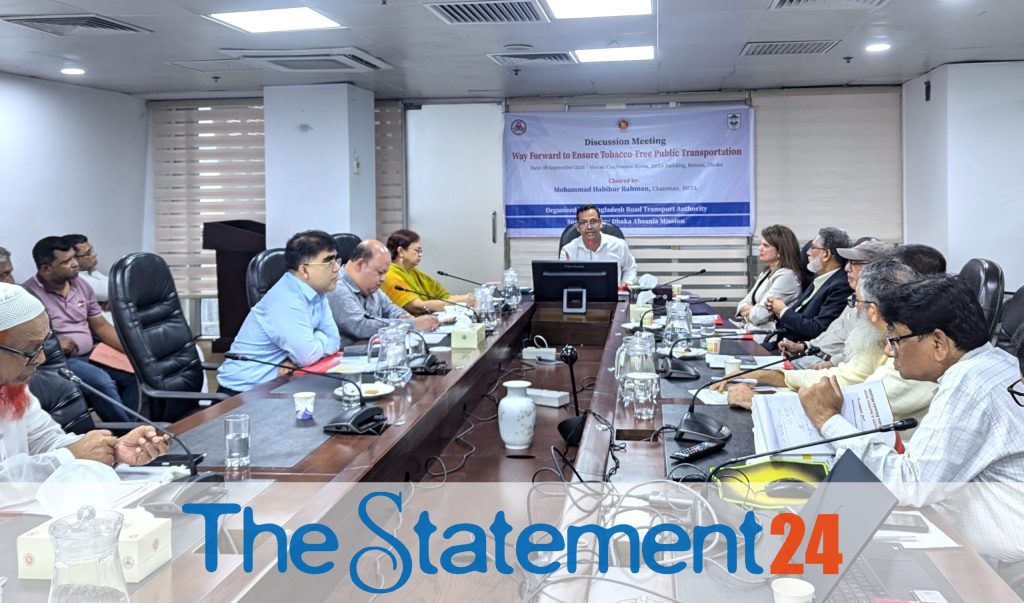
Stakeholders have called for making all public transport in Bangladesh 100 percent tobacco- and smoke-free to protect passengers and transport workers from the harmful effects of secondhand smoke.
They also urged authorities to ensure the display of legally mandated “No Tobacco Use and No Smoking” signs and warning notices on public transport and at all offices of the Bangladesh Road Transport Authority (BRTA), while taking stronger measures to enforce existing tobacco control laws.
The call was made at a meeting titled “Way Forward to Ensure Tobacco-Free Public Transport,” jointly organized by Dhaka Ahsania Mission and the Bangladesh Road Transport Authority (BRTA) at the BRTA conference room in Banani, Dhaka, on Wednesday afternoon (9 September 2026).
BRTA Chairman Mohammad Habibur Rahman said that, “As part of capacity-building activities to ensure a sustainable tobacco- and smoke-free public transport system, more than 61,000 public transport drivers have been trained with the support of Dhaka Ahsania Mission since 2019. This initiative will continue in the future to protect passengers and transport workers.”
Shariful Islam, Coordinator of the Tobacco Control Project at Dhaka Ahsania Mission, presented the keynote paper at the meeting. Citing data from the Global Adult Tobacco Survey (GATS) 2017, he said approximately 37.8 million people in Bangladesh use tobacco products, including around 19.2 million smokers. At the same time, nearly 40 million non-smokers are exposed to secondhand smoke.
He further noted that approximately 44 percent of people are exposed to secondhand smoke on public transport, describing the situation as a major public health concern.
The speakers said that passengers, particularly women and children, are involuntarily exposed to tobacco smoke when drivers and their assistants smoke on public transport. As a result, non-smokers are also exposed to serious health risks associated with secondhand smoke.
They emphasized that the BRTA should develop and implement an effective plan to ensure enforcement of the fines prescribed under the tobacco control law for tobacco use and smoking in public places and on public transport. Strict enforcement, they said, is essential to ensure that neither passengers nor drivers and helpers are allowed to smoke on public transport.
Several recommendations were presented at the meeting to make public transport and BRTA offices tobacco-free. These include ensuring the display of legally required “No Tobacco Use and No Smoking” signs and mandatory warning notices at all BRTA offices, including divisional and circle offices, as well as on public transport.
The recommendations also included conducting regular tobacco-control awareness programmes involving transport owners, workers and drivers, and increasing public awareness of tobacco control laws through the BRTA website, social media and other communication channels.
The speakers further called for greater awareness among transport owners and businesspeople about tobacco control laws and the health risks associated with tobacco use. They also recommended printing anti-smoking messages on bus tickets to reinforce public awareness.
They stressed the need for effective implementation of the existing Tobacco Control Act, as amended in 2013, and called for coordinated efforts among government agencies, transport authorities and relevant stakeholders to ensure a sustainable tobacco-free public transport system.
Dr. Mahin Malik, Regional Director (Programs), South Asia and Jordan, CTFK, attended the meeting as the distinguished guest. The meeting was chaired by Mohammad Habibur Rahman, Chairman of BRTA.
Dr. S.M. Khalilur Rahman, Vice President of Dhaka Ahsania Mission, delivered the welcome speech.
Among others, Mostafizur Rahman, former Chairman of BCIC; Mukhlesur Rahman, Deputy Director of the Health & Nutrition Sector of Dhaka Ahsania Mission; and senior officials of BRTA attended the meeting.