

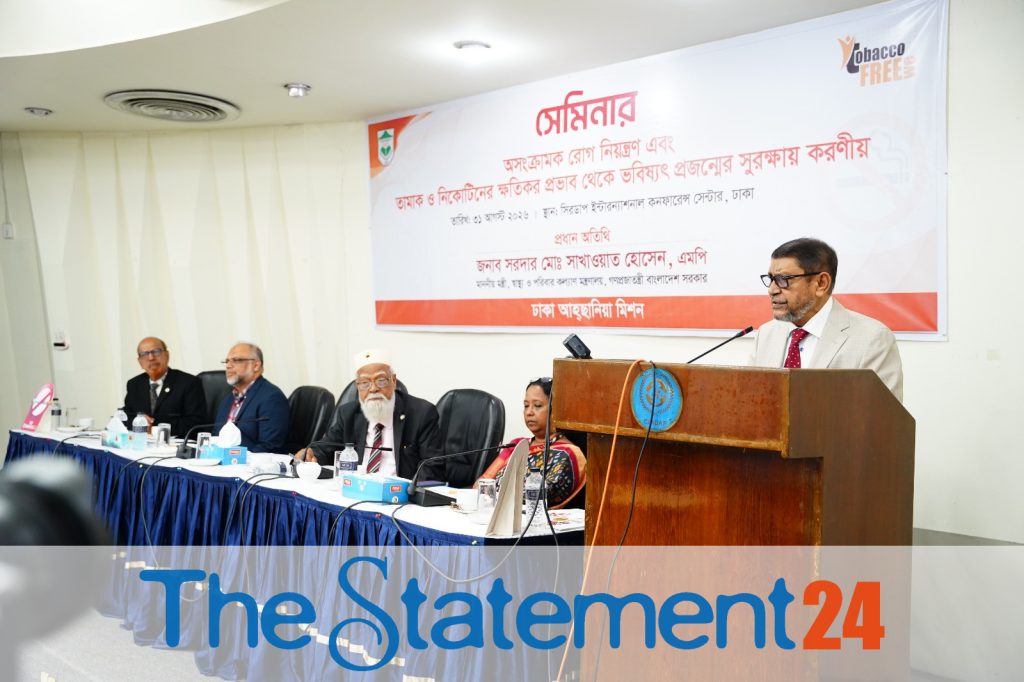
Approximately 71 percent of all deaths in Bangladesh are caused by non-communicable diseases (NCDs), and tobacco use is one of the major risk factors for these diseases. Therefore, tobacco control must be accorded the highest priority in addressing the burden of NCDs in Bangladesh, said Minister for Health and Family Welfare Sardar Md. Sakhawat Hossain.
He said, “Prevention of non-communicable diseases is not possible without effective tobacco control. Effective measures must be taken to reduce tobacco use in order to protect public health and safeguard the younger generation from nicotine addiction.”
The Minister made these remarks as the Chief Guest at a seminar titled “Actions to Control Non-Communicable Diseases and Protect Future Generations from the Harmful Effects of Tobacco and Nicotine”, organized by Dhaka Ahsania Mission (DAM) at the CIRDAP International Conference Center in the capital on Monday afternoon, 31 August 2026.
The Health Minister said that the current government has allocated the highest-ever budget for the development of the health sector in the national budget. However, tobacco remains one of the major obstacles to improving public health. He said the government is highly aware of the issue and is taking effective measures to strengthen tobacco control.
He further said that, as part of fulfilling the commitment made in the election manifesto, the Tobacco Control Act was further amended and strengthened and passed in 2026. He also emphasized the need for more effective, coordinated and timely measures for tobacco control in line with the WHO Framework Convention on Tobacco Control (FCTC).
Speakers at the seminar said that 37.8 million people in Bangladesh use tobacco products, resulting in approximately 200,000 premature deaths every year from tobacco-related diseases, equivalent to around 546 deaths every day.
They also stated that the combined health and environmental costs associated with tobacco amount to approximately BDT 870 billion (Tk 87,000 crore). Tobacco cultivation is also contributing to deforestation, depletion of soil fertility and increased use of chemical inputs.
Expressing concern over the exclusion of e-cigarettes from the amended Tobacco Control Act 2026, the speakers said that tobacco companies are employing various strategies to expand the market for their products by targeting the younger generation.
They called for stringent legal measures to ban the production, import, marketing and sale of e-cigarettes and other emerging nicotine products, as well as to prevent their promotion and easy availability. They also demanded the prompt formulation of rules under the amended Tobacco Control Act 2026.
The seminar was chaired by Professor Dr. Golam Rahman, President of Dhaka Ahsania Mission. Professor Dr. Syed Md. Akram Hossain, Chairman of the Department of Clinical Oncology at Bangladesh Medical University, attended as the Chief Discussant.
Other discussants included Sheikh Momena Moni, Additional Secretary of the Health Services Division, and Mostafizur Rahman, former Chairman of the Bangladesh Chemical Industries Corporation (BCIC) and the vice president of Dhaka Ahsania Mission S. M. Dr. Khalilur Rahman.
The welcome address was delivered by Iqbal Masud, Director of the Health and Nutrition Sector of Dhaka Ahsania Mission, while the keynote paper was presented by Shariful Islam, Project Coordinator.
More than a hundred participants, including government officials, physicians, public health experts, representatives of development organizations and students from various universities, attended the seminar.