

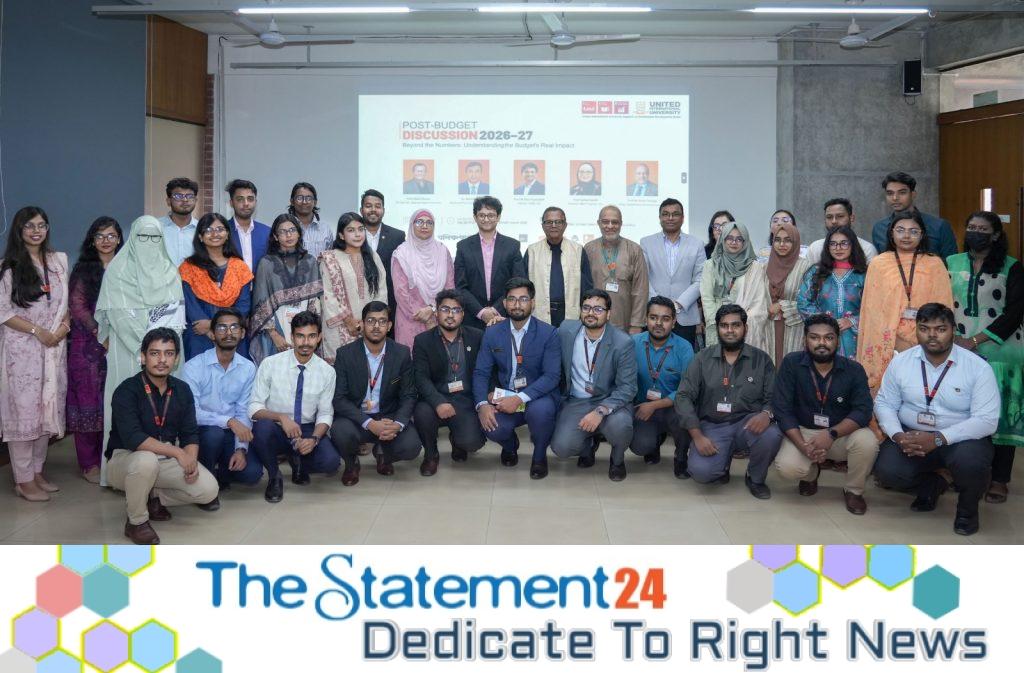
The School of Business and Economics of United International University (UIU) organized the Post-Budget Discussion Program 2026-27 yesterday at UIU Campus.
At the beginning of the program, two important sessions were held with the participation of students from different universities across the country. The first session featured a lively debate competition on the motion, “The proposed tax policy in the National Budget of Bangladesh for the fiscal year 2026–27 will be beneficial to the country’s economy overall,” with participants from the University of Dhaka, Jahangirnagar University and United International University. During the debate, the participating students analyzed various aspects of the national budget using data-driven arguments and logical reasoning.
Thereafter, a panel discussion was held where young women unpacked the budget, critically assessed its key priorities, and shared their vision for the future of Bangladesh. The participating students shared their views, expectations, and innovative ideas on various social, economic, and developmental aspects of the budget. Their insights and policy recommendations particularly impressed the distinguished guests present at the event.
In the main discussion session, the speakers discussed the overall context of the national budget, including the tax structure, revenue collection, investment, employment, trade and commerce, and various issues related to sustainable economic growth. They emphasized that ensuring transparency, accountability, efficient public management, and public participation is essential for the effective implementation of the budget. The speakers also highlighted the importance of involving young people in economic policymaking discussions and research.
Prof Abdul Bayes, former Vice-Chancellor of Jahangirnagar University, described the national budget as one of the principal instruments for achieving the country’s long-term economic development and inclusive growth. He also said that through the proper use and implementation of the budget, it is possible to increase productivity, create employment, and play an effective role in the welfare of the people and society.
Dr. Md. Nurul Amin, Additional Tax Commissioner of the National Board of Revenue (NBR), Government of Bangladesh, said the government is undertaking various initiatives to modernize the tax system, make it more technology-driven, and make it more taxpayer-friendly. He emphasized the need to raise public awareness about tax compliance and to foster a culture of voluntary tax payment.
Prof M. Niaz Asadullah, Advisor to the UIU School of Business and Economics, said that discussions on the national budget at the university level play a vital role in enhancing students’ analytical understanding of economic issues and increasing their awareness of public policymaking.
Prof Salma Karim, Director of the UIU BBA Program, said that students should be made aware of contemporary national and international economic issues rather than being confined solely to textbook-based learning.
In the concluding session, Prof M. Omar Farooq, Head of the Department of Economics, UIU thanked everyone present and said that constructive discussions on the national budget, along with the active participation of students, would play an important role in developing skilled economists, policymakers, and responsible citizens for the future.
Heads of different departments, faculty members, officials, students and distinguished guests were present in the discussion program.