

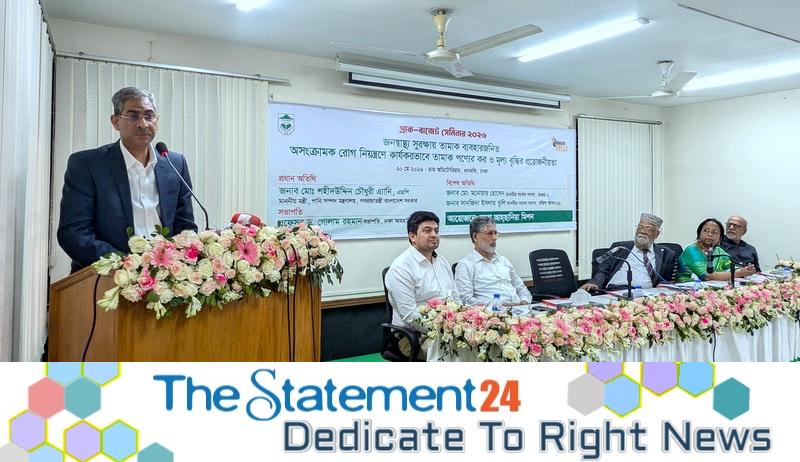
Minister for Water Resources Shahid Uddin Chowdhury Annie has stated that, effective taxation on tobacco products is necessary in the upcoming national budget for the fiscal year 2026–27 to protect public health.
Referring to the BNP’s electoral commitment to controlling non-communicable diseases caused by tobacco use, he further said that the government remains committed to this goal. He added that the issue of increasing taxes and prices on tobacco products to build a healthy, safe, and tobacco-free Bangladesh would be raised at the national parliament and relevant policymaking levels.
He made these remarks as the chief guest at a seminar titled “Need for Effective Tax and Price Increases on Tobacco Products to Control Tobacco-Induced Non-Communicable Diseases for Protecting Public Health”, organized by Dhaka Ahsania Mission on Wednesday (20 May 2026) in Dhanmondi, Dhaka.
The seminar was attended by former BCIC Chairman Mostafizur Rahman and Additional Secretary of the Health Services Division Sheikh Momina Moni as discussants.
Presenting the keynote paper, Professor Dr. Shafiun Nahin Shimul, Director of the Institute of Health Economics at University of Dhaka, stated that Bangladesh currently has a four-tier cigarette pricing system. Nearly 90 percent of cigarettes sold in the market belong to the low and medium tiers, making them highly accessible and rapidly addictive, especially for youth and low-income populations. Since the prices of low- and medium-tier cigarettes are very close, consumers can easily switch between the two categories. Additionally, the easy availability of smokeless tobacco products such as zarda, gul, and bidi is further increasing tobacco consumption.
Therefore, in the upcoming fiscal year, tobacco prices should be increased through effective taxation by merging the low and medium cigarette tiers and setting the minimum retail price at BDT 100 per 10-stick cigarette pack, BDT 150 for the high tier, and BDT 200 for the premium tier. At the same time, a 67 percent supplementary duty should remain in place across all tiers, along with a specific tax of BDT 4 per pack.
If these proposed tax and price measures are implemented, more than 372,000 youths would be discouraged from initiating smoking, and in the long term, over 185,000 premature deaths among young people could be prevented. Moreover, the government could generate approximately BDT 85,000 crore in revenue from the tobacco sector, which is around BDT 44,000 crore higher than the current fiscal year.
Sheikh Momina Moni stated that Bangladesh has the highest tobacco use rate in South Asia at 35.3 percent. As a result, nearly 200,000 people die prematurely every year from tobacco-related diseases in the country. In 2024, the health and environmental damages caused by tobacco amounted to approximately BDT 87,000 crore, which is more than double the revenue earned from this sector.
She further added that increasing taxes and prices on tobacco products in the upcoming budget would help the country move further toward achieving public health goals. Revenue generated from the proposed tobacco tax reforms would significantly contribute to strengthening Bangladesh’s health sector. Through effective tobacco taxation aligned with inflation and income growth, the government would be able to reduce the burden of tobacco-related diseases while also ensuring sustainable financing for health sector reforms.
The seminar was chaired by Professor Dr. Golam Rahman, President of Dhaka Ahsania Mission. Welcome remarks were delivered by Mukhlesur Rahman, Deputy Director of the Health Sector. Other speakers included SM Dr. Khalilur Rahman, Vice President of the Mission; Shariful Islam, Coordinator of the Tobacco Control Project; and Marjana Muntaha and Tasnim Hasan Abir from the Ahsania Mission Youth Forum.