

Bagerhat sits where the Sundarbans meets the Bay of Bengal — tidal, low-lying, and increasingly saline. Cyclones, tidal surges, and erratic rainfall have repeatedly rewritten its agricultural map, leaving farmers to battle salt-laden soil, scarce freshwater, and climate uncertainty every season. In this landscape, every drop of water, every inch of arable land, and every informed decision can mean the difference between survival and loss.
Against this backdrop, BRAC Bank, in collaboration with BRAC, launched Aporajeyo Desh in 2025 — a flagship CSR initiative aimed at building climate resilience, environmental sustainability, and livelihood security for vulnerable coastal communities. The programme spans four upazilas — Sarankhola, Morrelganj, Mongla, and Rampal — reaching nearly 46,000 people through integrated interventions in water, agriculture, and advisory services.
Water as Lifeline
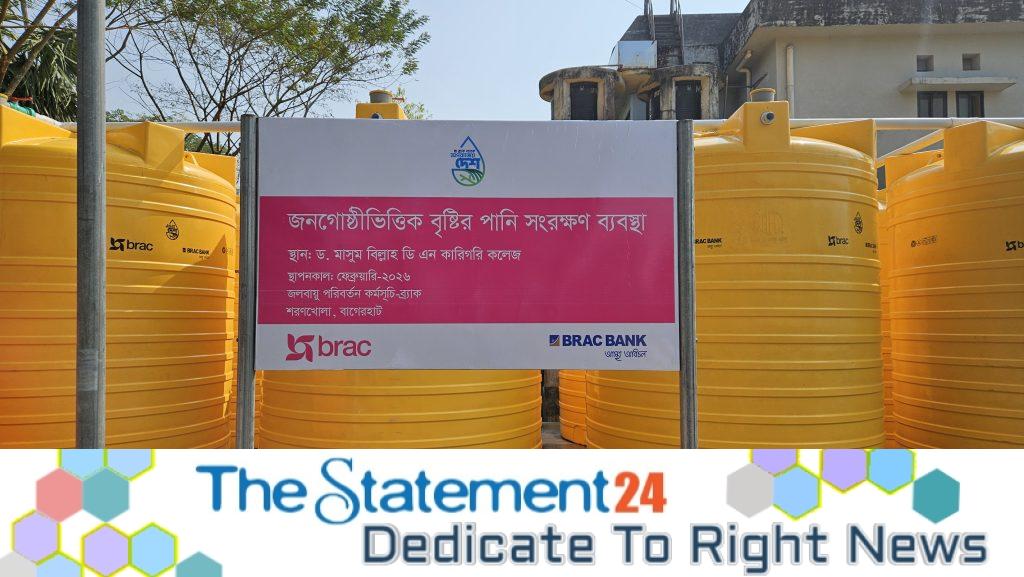
Saline intrusion has made safe drinking water a daily struggle. In response, Aporajeyo Desh has installed 15 community-level rainwater harvesting systems and 180 household-level units, with full operation expected by June 2026. These yellow tanks do more than store water: they return hours to women who once spent their days fetching water, reduce waterborne illnesses, and restore dignity and productivity. Communities actively manage these systems, from committee formation to maintenance planning, ensuring ownership and sustainability.
Fields of Opportunity
The programme’s eco-friendly agriculture interventions are transforming barren or salt-affected land into productive plots. Nearly 3,700 farmers have received climate-resilient seeds, bio-fertilizers, and bio-pesticides, while 30 high-value demonstration plots showcase what adaptive farming can achieve. Farmers grow sunflower, mustard, maize, dyke vegetables, and homestead crops using compost, pheromone traps, and yellow sticky traps, combining tradition with climate-smart innovation. Solar-powered irrigation pumps at three community sites reduce dependence on diesel, cutting costs and carbon emissions.
Empowerment in Action
The programme’s impact is best measured in the lives it touches.
Sumi Begum, 33, a homemaker from Sarankhola with no prior farming experience, transformed her five-decimal homestead plot into a thriving vegetable garden. Within her first season, she earned BDT 15,000 and is now expanding her plot and crop mix.
Renuka Rani Mistry, 45, a former trained midwife from Morrelganj, earned BDT 50,000 in a single season cultivating sweet gourd, bottle gourd, broccoli, squash, beetroot and a number of crops. She now trains other women in climate-resilient agriculture, multiplying the programme’s impact.
Knowledge as Infrastructure
At the heart of Aporajeyo Desh lies the Adaptation Clinic, both office-based and mobile, which provides real-time advisory services. Over 4,000 farmers now receive guidance on crop disease management, soil care, and sustainable pest control, alongside agrometeorological voice SMS alerts to plan planting around weather and tidal forecasts. Knowledge is treated as critical infrastructure — as essential as water tanks or resilient seeds.
Kazi Jalaluddin, a smallholder farmer in Rampal, applied techniques learned at the Adaptation Clinic, including integrated pest management and soil care, increasing his maize yield while reducing chemical inputs.
Scale and Sustainability
Communities manage water systems, monitor crops, and adopt eco-friendly practices, ensuring that interventions are owned and maintained locally. Complementing agriculture and water support, the programme also promotes Amar Ban agroforestry, with 45 community plots and 30 homestead plots planted, reinforcing both environmental sustainability and local food security.
A Blueprint for Climate Resilience
Aporajeyo Desh proves that climate adaptation is not abstract — it is actionable, measurable, and replicable. Each tank of water, each resilient seed, each farmer trained builds a foundation for communities to thrive in the face of climate uncertainty. Across Sarankhola, Morrelganj, Mongla, and Rampal, nearly 46,000 people are now living evidence that deliberate, knowledge-driven, and community-owned interventions can turn vulnerability into opportunity.
In the saline prone areas of Khulna and Bagerhat, every drop matters, every inch matters. Every empowered life is a blueprint for what is possible when knowledge, land, water, and agency converge.