

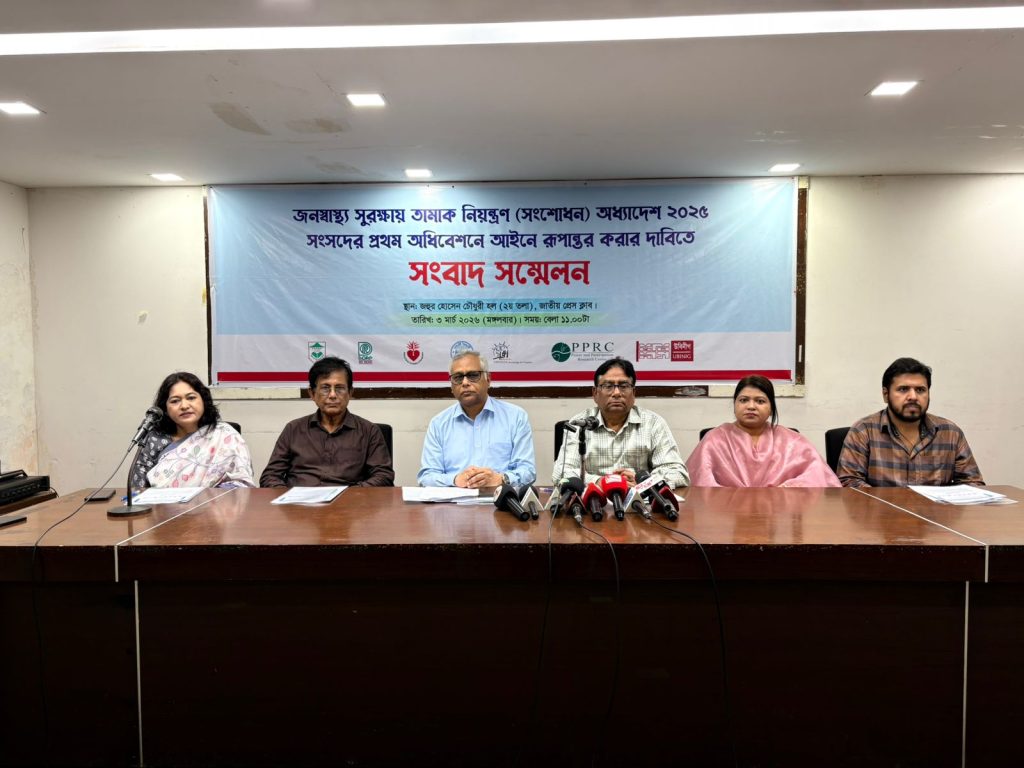
Anti-tobacco organizations have urged that the Smoking and Tobacco Products Usage (Control) (Amendment) Ordinance, 2025 be enacted into law during the first session of the 13th National Parliament to safeguard public health from the harmful effects of tobacco.
Speakers made the demand at a press conference titled “Call for Enactment of the Tobacco Control (Amendment) Ordinance 2025 in the First Session of Parliament to Protect Public Health”, held today (Tuesday, 3 March 2026) at the Zahur Hossain Chowdhury Hall of the National Press Club. They noted that if the ordinance is not passed within 30 days of being placed before Parliament, it will lose its validity.
The keynote paper was presented by Dr. Aruna Sarkar, Coordinator of the Tobacco Control Program at the National Heart Foundation Hospital & Research Institute. Citing The Tobacco Atlas 2025, she said that approximately 21.3 million people aged 15 years and above in Bangladesh use tobacco, and nearly 200,000 people die each year from tobacco-related diseases—an average of 545 deaths per day. Scientific research confirms that secondhand smoke is as harmful as direct smoking. Therefore, protecting citizens from exposure to secondhand smoke is a constitutional responsibility of the state.
She further noted that Bangladesh was the first signatory country to the World Health Organization Framework Convention on Tobacco Control in 2003, and subsequently enacted the Tobacco Control Act in 2005. She also mentioned that the Bangladesh Nationalist Party (BNP), in its election manifesto, emphasized controlling non-communicable diseases (such as cancer, stroke, heart disease, and respiratory illnesses) caused by tobacco use and committed to taking necessary legal and policy measures to reduce tobacco consumption.
The press conference highlighted that the ordinance includes provisions to: ban smoking in all public places and public transport without designated smoking areas; prohibit point-of-sale display, advertising, and promotion of tobacco products; increase pictorial health warnings on cigarette packs to 75 percent; and ban the sale of tobacco products within 100 meters of educational institutions, hospitals, and sports facilities. Speakers stated that these measures would reduce premature deaths, lower healthcare costs, and protect young people from tobacco addiction.
Md. Mokhlesur Rahman, Deputy Director of the Health Sector at Dhaka Ahsania Mission, described the ordinance as a landmark initiative to protect public health and the younger generation, and called for its passage in the first parliamentary session.
In his presidential remarks, Professor Dr. Sohel Reza Choudhury, Head of the Department of Epidemiology and Research at the National Heart Foundation Hospital & Research Institute, said that once enacted, the law would protect non-smokers from secondhand smoke and significantly reduce tobacco-related illness and mortality. He warned that failure to pass the law could hinder Bangladesh’s progress toward achieving the Sustainable Development Goals (SDGs) by 2030. He reiterated the call for immediate enactment of the ordinance during the first session of Parliament.
The press conference was moderated by Khadijatul Kubra, Program Officer of Dhaka Ahsania Mission. Among others, speakers included Zeba Afroza, Program Coordinator of Development Organization of the Rural Poor (DORP); Hasanul Hasib Al Galib, Project Coordinator of UBINIG; and representatives from PPRC.
Representatives from Dhaka Ahsania Mission, DORP, National Heart Foundation of Bangladesh, Naripokkho, PROGGA (Knowledge for Progress), PPRC, UBINIG, along with journalists, were also present at the event.