

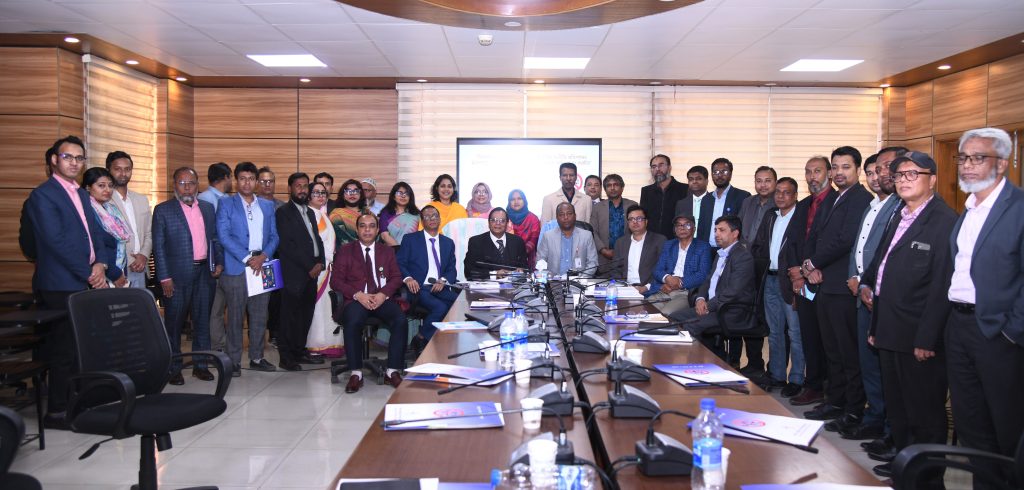
The Department of Mass Communication and MANAS (Association for the Prevention of Drug Abuse) will work jointly to ensure the effective implementation of the Tobacco Control Ordinance 2025, enacted through amendments to the Tobacco Control Law, which prohibits the depiction of smoking and tobacco use in entertainment media, and to enhance public awareness at the grassroots level.
Distinguished speakers called upon stakeholders, including those from the entertainment industry, to come forward in this regard. The call was made at a meeting titled “Compliance with Laws and Policies to Stop Smoking Scenes in Entertainment Media: Roles of the Department of Mass Communication in Building Grassroots Awareness,” held on Wednesday afternoon, 28 January 2026, at the Information Building. The meeting was jointly organized by the Department of Mass Communication and MANAS.
The meeting was graced by Mr. Md. Abdul Jalil, Director General of the Department of Mass Communication, as the Chief Guest. The session was chaired by Professor Dr. ArupRatan Choudhury, Founder President of MANAS.
Speakers at the event included Ms. Masuma Rahman, Managing Director of Bangladesh Film Development Corporation (BFDC); actress and Film Certification Board member Ms. Kazi Nowshaba Ahmed; Mr. Syed A. Momen, Director, Department of Mass Communication; Mr. Mohsin Faraji, Executive Magistrate, Dhaka District Administration; Mr. Sirajul Islam Khan, Assignment Officer, NGO Affairs Bureau; and Mr. Hamidul Islam Hillol, Project Director, Bureau of Economic Research, University of Dhaka, among others.
The keynote paper was presented by Aminul Islam Sujan, Technical Advisor, Vital Strategies, while the closing remarks were delivered by Motiour Rahman Talukder, Organizing Secretary of MANAS. The session was moderated by Md. Abu Raihan, Senior Project and Communication Officer of MANAS.
Speakers emphasized the need for effective implementation of the Tobacco Control Ordinance, rapid finalization of the OTT policy, and formulation of a comprehensive guideline.
In his presentation, Aminul Islam Sujan stated that more than 161,000 people die every year in Bangladesh due to tobacco use. Under the Smoking and Tobacco Products Usage (Control) Amendment Ordinance 2025, the display of tobacco scenes in entertainment media and OTT platforms has been prohibited. However, smoking scenes continue to appear in films, dramas, and web series in various forms, encouraging tobacco use among young people. He further noted that countries such as India, Sri Lanka, Thailand, and Bhutan strictly regulate tobacco depiction in films and television, a practice Bangladesh should also follow. He urged the Department of Mass Communication and relevant authorities to strengthen grassroots awareness and recommended the formulation of clear OTT guidelines.
Chief Guest Md. Abdul Jalil said, “Everyone should come forward for good causes. Promoting smoking and drugs means pushing the next generation toward danger. Although anti-smoking laws and policies exist, enforcement alone is not enough. The fight must begin at the family level. We must change our value system and build public opinion against drugs and smoking.”
He added that in line with the Smoking and Tobacco Products Usage (Control) Act 2005 (Amendment Ordinance 2025) and its institutional mandate, the Department of Mass Communication will play an active role. Through district information offices, messages on tobacco control will be disseminated via courtyard meetings, community gatherings, women’s assemblies, youth forums, cultural programs, and musical events. On this occasion, he also announced that all offices of the Department of Mass Communication will be declared tobacco-free.
Professor Dr. AroupRatan Choudhury stated that tobacco scenes in entertainment media pose one of the greatest risks to young people, as smoking often serves as a gateway to drug addiction. He described the government’s issuance of the Tobacco Control Ordinance 2025, which bans smoking scenes across all entertainment media, as a landmark step. He highlighted that MANAS has long been working at the policy level through monitoring and evidence-based research on tobacco depiction in films, dramas, and OTT platforms. He stressed that the role of the Department of Mass Communication is crucial in law enforcement and public awareness, as reducing tobacco use is possible through behavior change and awareness. He sought the Department’s cooperation in finalizing the OTT policy.
Mohsin Faraji said that mobile courts would be conducted based on discussions from the District Commissioner’s office to enforce the tobacco control law.
Sirajul Islam Khan stated that he would discuss with the Director General of the NGO Affairs Bureau to ensure that all NGO offices are maintained as smoke-free zones in accordance with the law.
Representatives from the Bangladesh Film and Publication Department, Development Activities of Society (DAS), Grambangla Unnayan Committee, and the Department of Mass Communication were also present at the meeting.