

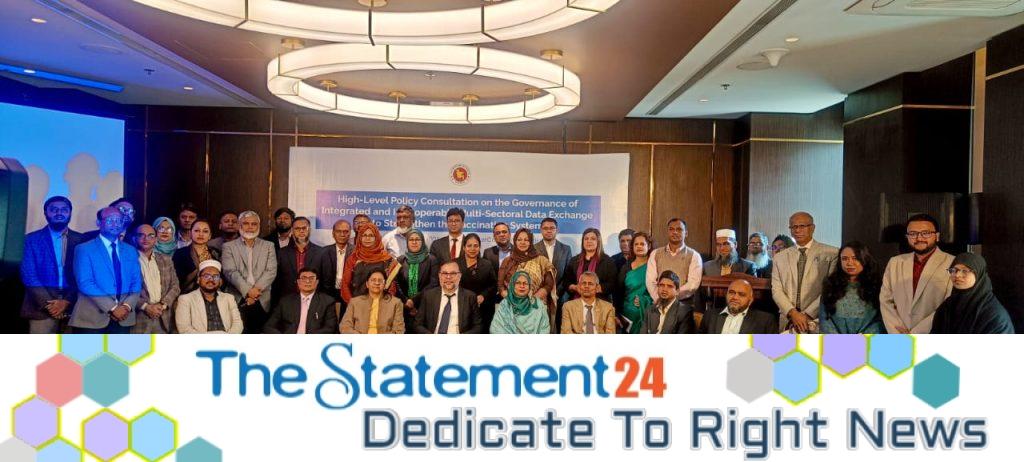
To make Bangladesh’s routine immunization system more effective and sustainable, the Government has taken an initiative to implement an integrated and interoperable inter-ministerial data exchange platform. To operationalize this effort, the Government announced the formation of a Strategic Committee comprising representatives from the relevant ministries and departments, alongside a Technical Committee composed of technical experts. The Expanded Programme on Immunization (EPI) vaccine delivery system will be used as the initial use case, and the challenges and results emerging from its implementation will be leveraged as the foundation for building a national interoperability framework.
The announcement was made today at a high-level policy meeting held in Dhaka by Shish Haider Chowdhury, Secretary, ICT Division and Zaheda Parveen, Secretary (Coordination & Reforms), Cabinet Division. The meeting was organized jointly by Aspire to Innovate (a2i), the ICT Division, and UNDP Bangladesh, under the leadership of the Cabinet Division.
Among other speakers and participants were Dr. Ashrafi Ahmad, Director General of the Directorate General of Family Planning; Md. Mamunur Rashid Bhuiyan, Additional Secretary (Administration Wing), ICT Division; Md. Abdur Rofiq, Project Director (Joint Secretary) a2i; Md. Kamrul Hasan, Joint Project Director (Joint Secretary), a2i; Md. Rashidul Mannaf Kabir, Joint Project Director (Joint Secretary), a2i; Md. Mozibor Rahman, Joint Secretary, ICT Division (Digital Governance & Security Wing); Dr. Abu Ahammad Al Mamun, Director (MIS), Directorate General of Health Services; Abdullah Al Fahim, Program Management Lead, a2i; Anowarul Arif Khan, Data & Research Cluster Head, a2i; and Maha Abu Emier, International Project Manager, a2i.The workshopwas moderated by Dr. Shabnam Mostari, Head of Digital Health, a2i.
Speaking at the workshop, Shish Haider Chowdhurynoted that citizen information currently exists across multiple systems, including birth registration, Civil Registration and Vital Statistics (CRVS), EPI, education, and identity services. Yet these systems are not connected. As a result, citizens often have to submit the same information repeatedly, leading to time and resource losses and affecting service quality. He explained that once an integrated data exchange platform is introduced, information collected once can be securely reused across authorized systems, enabling data captured at birth to support immunization, school enrolment, national identity services, passport-related processes, and other services in a seamless manner. He added that such data-driven integration would also support evidence-based planning and target setting, improve vaccine demand forecasting, enable real-time updates, and make it easier to ensure that all eligible children and adolescents are brought under full immunization coverage, reducing citizen hassle and improving administrative efficiency.
Zaheda Parveen stated that under the National Data Management Ordinance 2025, the Cabinet Division has the mandate to coordinate government-wide interoperability, and reaffirmed that the Cabinet Division will extend full cooperation as the ICT Division advances implementation. The importance of aligning birth registration numbers and the National ID system to ensure a consistent unique identity for citizens. She further observed that earlier implementation gaps, particularly around nationwide adoption of digital architecture across agencies, due to the absence of a clear legal basis, can now be addressed through the National Data Management Ordinance 2025 and the Personal Data Protection Ordinance 2025. She concluded that successful implementation of this initiative would institutionalize interoperability in government data exchange and establish a new benchmark for citizen-centric public service delivery in Bangladesh.